Showing posts with label lu cafausu. Show all posts

February 5, 2016

Uno specchio per cinque, Zurich


Emilio Fantin, Luigi Negro, Giancarlo Norese, Cesare Pietroiusti, Luigi Presicce (Lu Cafausu):
Uno specchio per cinque

In the crypt of the Cabaret Voltaire a set will be constructed with the aim of shooting the first scene of a film. In this scene five non-professional actors will be invited to interpret and repeat the personal obsessions of the five components of “Lu Cafausu” who will take the role of directors. The public will be very close to the action and, at times, will inevitably become part of it.
Through this film the five artists will be confronted with their own self, their mirrored images, their contradictions.

Inaugural performance for Obsession Dada, Cabaret Voltaire, Zurich
February 5, 2016

/

Ab dem 5. Februar 2016 wird zum 100-Jahre Jubiläum von Dada im Cabaret Voltaire, dem Geburtsort von Dada, die Ausstellung «Obsession Dada» gezeigt. Sie basiert auf Dokumenten aus dem Archiv des Kurators Harald Szeemann. In Szeemanns «Museum der Obessionen» hatten auch Dada und die Dada Erben einen Platz. Für «Obsession Dada» werden Dokumente über das Museum der Obsessionen und die Agentur für geistige Gastarbeit publiziert.

Mit einer von Una Szeemann konzipierten, raumgreifenden Installation wird eine Bühne für Obsessionen geschaffen, die wöchentlich mit Performances, Lesungen und Manifesten bespielt wird: Den Auftakt macht am 5.2. das Kollektiv Lu Cafausu, gefolgt von Oppy De Bernardo & Aldo Mozzini, Garret Nelson, Pilar Albarracin, Thomas Hirschhorn, Michele Robecchi, Gianni Motti, Nedko Solakov, Grupo EmpreZa, Carlos Amorales, Shana Lutker uvm.

Parallel widmet sich Adrian Notz im täglichen Offizium um 6:30h den 165 DadaistInnen. Am Feiertag von Hans Arp wird die «Die Schwalbenhode» vortragen. Sophie Taeuber-Arp wird am 24. Februar. zelebriert. Wahrlich gefeiert wird allabendlich, an den Soiréen. So wird zum Beispiel mit 6 Tänzerinnen und einer Puppenspielerin am 10. Februar die Marionette «The Robot King» von Sophie Taeuber-Arp zum Leben erweckt, nach einer 36 stündigen «Hacktion» spielt am 5.März die Genfer Kultband «The Death Brothers» oder die internationale Performance Gruppe «Blago Bung», deren Name vom lautmalerischen Ausdruck von Hugo Ball abgeleitet wurde, kreiert für den 9 April ein Lyrik-Konzert.

«Obsession Dada»
5. Februar–15. Mai 2016
Dokumente aus dem Harald Szeemann Archiv
Wöchentliche Soiréen mit zeitgenössischen KünstlerInnen

165 Feiertage
täglich: Offizien
6:30 Uhr, 5. Februar–18. Juli 2016
Soiréen

20:00 Uhr, 5. Februar–15. Mai 2016

November 2, 2015

La Festa dei vivi (Lac o Le Mon), San Cesario di Lecce

2 novembre 2015, dalle 12 alle 24
La Festa dei vivi (che riflettono sulla morte)

Il 2 novembre 2015, come da tradizione, si celebra La Festa dei vivi (che riflettono sulla morte), giunta alla sua sesta edizione. Vi invitiamo anche quest’anno a seguirci, con la sola certezza che ci accoglierà l’inaspettato.

La vena nomadica pervade ancora il nostro procedere, ma questa volta misureremo l’orizzonte su architetture di pietra e di pensiero.
Le voci delle comunità di visibili e invisibili continueranno a farsi sentire? Accetteranno di condividere con noi l’odore di un agrumeto nero, disegnato dalle geometrie di un hortus conclusus

Riecheggeranno da cavità sotterranee, non descritte in alcuna mappa catastale, a indicarci una via, un pertugio segreto o magari a celarlo, ingannandoci?

Assieme ascolteremo l’eco dei sussurri e dei canti di chi ha abitato quelle stanze dalle altissime volte, per rinviarli da un terrazzo, come vapore o fumo, al tramonto.

Emilio Fantin, Luigi Negro, Giancarlo Norese, Cesare Pietroiusti, Luigi Presicce.


November 2, 2014

The Celebration of the Living (who reflect upon death), 5


San Cesario di Lecce, Italy, Oct. 25 to dawn of Nov. 2, 2014

I am Beatrice who urges you to journey,

Come from a place to which I long to return.
Love moved me to speak my heart to you.

(Inf. II, 70-72)


Let us summon one dear to us, a deceased friend or loved one, and take him or her with us, from the first moment to the end of a journey.
Each person who decides to participate in “The Celebration of the Living (who reflect upon death),” in its fifth edition this year, is invited to bring along someone they have lost, to create a particular and pervasive dimension of accompaniment, starting with the preparations for the departure to reach San Cesario di Lecce.
Each can bring to life this voyage-in-company in the way they deem best, relying on imagination, intuition, storytelling. Will this presence/absence guide our steps and our encounters, in order to speak, like Beatrice, with us and for us?
This year the Celebration of the Living, instead of a single pilgrimage on November 2nd, will extend through a longer period and be enlivened by an unusual form of participation, between the dead who speak through the living, and the living who meet through the dead.
With total freedom, each person can decide if and when to introduce others to the invisible presence that accompanies them: for this to happen, we simply propose a space (Lu Cafausu) and a time (at dawn, every day from October 25th to November 1st).
Across this span of days, the theme of the compresent relationship between the living and the dead will form the backdrop of gestures and conversations, until November 2nd, the final day, in which we will gather by walking, visible and invisible, from dusk towards dawn.

The fifth edition of “The Celebration of the Living (who reflect upon death)” has been realized in the context of Free Home University, with the active participation of Mattia Pellegrini, Davide Ricco, Sara Alberani, Luca Musacchio, Sarah Ciracì, Gianluca Marinelli, Matteo Greco, Roberto Tenace, Carlo Marchetti, Lisa Batacchi and other new friends.

April 3, 2014

Gelosia, Cully


GELOSIA
An exhibition by Emilio Fantin, Luigi Negro, Giancarlo Norese, Cesare Pietroiusti, and Luigi Presicce

April 26 to June 8, 2014
KMD – KUNSTHALLE MARCEL DUCHAMP
Cully, Switzerland

Gelosia (Jealousy) was the name of the boat that in 2010, with the help of many friends and the public, the Italian artists pushed along the streets of a village in southern Italy during the first edition of an annual event they called “The Celebration of the Living (who reflect upon death).”

The artists proposed to turn the traditional November 2nd celebration, the “Day of the Dead,” into this new holiday. For the first edition of this feast, on November 2nd, 2010, they invited those who were interested to be part of a pilgrimage, probably the shortest and slowest in the world, that departed from its destination (rather than arriving at it): Lu Cafausu in San Cesario di Lecce.

Lu Cafausu is a mysterious small building, an architectural remnant that the artists have elected as a source of metaphors and narratives. It is “an imaginary place that really exists,” around which the presence of death floats. Any day, the small building might in fact be demolished to accommodate more parking space for cars, or might also fall apart due to its precarious, old architecture. It could also be turned into a frozen, dead monument. Because of this feeling of the presence of death, Lu Cafausu is an ideal place for a new celebration. The Celebration of the Living or, in Italian, “La Festa dei Vivi,” is for those who, in order to give meaning to life, reflect upon death; their own, “first and foremost.”

In an ideal continuation of this journey, which deals with our common destiny, with the death of Courbet nearby “Duchamp’s waterfall,” with the origin of the world, with any erotic feeling that could match death, with coincidences, with the unexpected, with chaos… the artists decided to realize a reproduction of the boat Gelosia that will include a secret, referring to something very personal, jealously kept, owned by them.

www.akmd.ch

Viewing Gelosia at KMD
La chute d'eau


December 1, 2012

La Festa dei Vivi 3, San Cesario di Lecce


First of all we would like to sincerely thank all those who have sent their words relative to the encounter of November 2nd. We have received hundreds of contributions as well as the feeling of an experience that has been strongly shared. An experience that evokes the limitlessness of a space that belongs to all of us, as well as those that are no longer with us.

Over the day of December 1st, we recorded all the words and sentences sent by the participants, using the old "fresco" technique, on the walls of "Lu Cafausu". It was a moment of celebration and reflection, as well as an attempt to create a physical space where all the individual stories, references and affects can compose a whole. It also functioned as a homage to "Lu Cafausu", an "imaginary place that really exists".
We met on December 1st, 2012, from noon to the sunset, around "Lu Cafausu".

In early November, people from across the world celebrate the Day of the Dead, remembering those who passed away and often visiting their graves. In one way or another, we all try to establish contact with our loved ones, and sometimes we consider our own common and mortal destiny, therefore reflecting upon death in general.

On occasion of the 3rd edition of “The Celebration of the Living (who reflect upon death)”, we have proposed a collective action, open to everyone, which has been held in different places at the same time. Each participant has met his/her loved ones, friends and relatives who passed away. Everyone has tried to imagine and configure the right way to get in touch with the dead either through ritual, gesture, or thought.

A plurality of people was in contact, at exactly the same moment, with others who are no longer with us. This created a shared space of life and death. A space between they, the dead, and we, the living, who share their destiny of finitude.

All contributions sent by participants can be found at www.lucafausu.tk.
Thanks to Marsèlleria for its support and for making this event possible.
Community partner: UnDo.Net

November 8, 2012

Combine Studios, Phoenix

On the way to the Guadalupe Cemetery.
A meeting organized in the context of “The Celebration of the Living (who reflect upon death)”, 3rd edition, took place in Arizona.

As a part of their stay at the Arizona State University Art Museum’s International Artist Residency Program, on Nov. 8th, 2012 Emilio Fantin and Giancarlo Norese introduced the project at Combine Studios on Roosevelt Row in Phoenix.

Since 2010, every Nov. 2nd, they consider the relationship between the living and the dead by organizing a public art event. 
This was the first of a series of meetings that will help develop a collaborative process for the realization of the 4th edition that will be taking place in Phoenix in the Fall of 2013.
In Phoenix, there is new creative energy developing constantly. The diverse cultural and artistic scenes present in the city make it fertile ground for the success of this project.
With the local community help and valued participation the project can continue and become more dynamic.

Some discussions on different notions of life and death have been organized, as well as interviews, visits and explorations of the area.

Thanks to Premio NCTM e l'Arte, 2012.


Thu. Nov 8th, 2012
6:00 pm
The Celebration
of the Living
Public Meeting and Dinner
Combine Studios
821 N 3rd St.
Phoenix, AZ 85004

October 17, 2012

A first step towards coincidences & meetings

SomethingLikeThis
è lieta di segnalare la partecipazione a

Independents3
nell'ambito di ArtVerona 2012
col progetto

A first step towards coincidences & meetings, Part II

Data: 18-22 ottobre
Luogo: Padiglione 6
Quartiere fieristico di Verona
Ingresso da viale del Lavoro

con Lisa Batacchi, Tony Fiorentino, Simone Ialongo, Virginia Zanetti

Il neo nato spazio SomethingLikeThis partecipa Indipendents-ArtVerona con gli artisti della prima mostra "A first step towards coincidences and meetings, Part I". In quest’occasione verrà riproposto il tema della mostra ampliato con nuove possibilità installative, in un confronto con un pubblico più ampio attraverso talks e momenti di discussione partecipata.
Gli artisti realizzano per lo spazio della fiera un “salotto artistico” con oggetti e libri di riferimento per la loro ricerca. Un ambiente informale e accogliente, esito di un movimento nomade e della necessità di apertura verso l’altro, dove sarà possibile discutere col pubblico le tematiche della mostra insieme ad altri artisti e invitati. L’esperienza di condivisione in fiera sarà documentata con video e foto.
In questa occasione verrà presentato del materiale informativo su SLT e gli esiti di "A first step towards coincidences & meeting, Part I".


programma Talks:

Giovedì 18 ottobre
ore 16. Egle Prati presenta il progetto Talkingart

Venerdì 19 ottobre
ore 16,30. Maria Pecchioli di FOSCA presenta lo spazio Frau Frisör Fosca e il progetto di residenza per collettivi e no profit a Corniolo Art Platform curata da Radical Intention

Sabato 20 ottobre
ore 16,30. Ermanno Cristini di RISS(E) in dialogo con Alessandro Castiglioni: Ospitalità e “ritardo”, pratiche artistiche come pratiche di dialogo

Domenica 21 ottobre
ore 16,30. Luigi Negro e Cesare Pietroiusti presentano "The celebration of the living (who reflect upon death)" / "La festa dei Vivi (che riflettono sulla morte)”, parte del progetto collaborativo Lu Cafausu (Emilio Fantin, Luigi Negro, Giancarlo Norese, Cesare Pietroiusti, Luigi Presicce)


Preview: giovedì 18 ottobre dalle 14.00 (solo su invito)
Apertura al pubblico: giovedì 18 ottobre dalle 15.30 alle 20.30; venerdì 19 – domenica 21 dalle 10.30 alle 19.30; lunedì 22 dalle 10.30 alle 15.00.

Independents3: nasce con l’intento di dare spazio e visibilità alle realtà artistiche e culturali maggiormente sperimentali, che si muovono in maniera autonoma rispetto al sistema istituzionale e che sono spesso catalizzatrici di nuove tendenze. Ideato da Fuoribiennale e curato da Cristiano Seganfreddo, ha visto la partecipazione di oltre 40 realtà, da Archivio Bonotto a IUAV, da Fondazione Buziol a Interzona, da Fondazione March a Sottobosco, da C4 a Spazio XYZ a Viafarini. (pad. 6 e 7)


Info:

SomethingLikeThis
Via Giuseppe Giusti 16, Firenze
www.sltartinitiatives.tumblr.com
info @ lisabatacchi.com

Fuoribiennale, www.fuoribiennale.org
Artverona, www.artverona.it

August 26, 2012

Lu Cafausu unworkshop, Kassel

And And And schedule at Turnhalle, d(13) Kassel
Lu Cafausu unworkshop at AND AND AND, Kassel, August 20-22.

AND AND AND is an artist run initiative, which has used the time between 2010 and dOCUMENTA (13) in 2012 to consider with individuals and groups across the world the role art and culture can play today and the constituent publics or communities which could be addressed.

The series of interventions, situations, and occurrences entitled AND AND AND are part of dOCUMENTA (13) and compose a map of emergent positions, concerns, and possible points of solidarity.

Date/Time
Date(s) - 22/08/2012
5:00 pm - 9:00 pm

Day (75) / Lu Cafausu / Unworkshop / Turnhalle / 22.August

- – - – - – - – - – - – - – - – - – - – - – - – - – - -
sketch
- – - – - – - – - – - – - – - – - – - – - – - – - – - -
Day (75): Wednesday, August,22 2012
Time: 5:00 pm
Location: Turnhalle
What: Unworkshop
Who: Emilio Fantin, Cesare Pietroiusti, Luigi Presicce, Luigi Negro, Giancarlo Norese

- – - – - – - – - – - – - – - – - – - – - – - – - – - -
Description
- – - – - – - – - – - – - – - – - – - – - – - – - – - -
1) Each participant will introduce themselves by showing or playing their contribution. Collective discussion.
2) Introduction to the theme of the island, as a metaphor of a space that follows the experience of a passage and of a transformation, and as an evocation of the realm of the dead ones.
3) Drawing workshop on the theme of the island.
4) Presentation of the third edition of the Celebration of the Living (who reflect upon death), November 2, 2012.
5) Dinner.

http://andandand.org

October 27, 2011

The Celebration of the Living 2, Venezia/Lecce

The Patience Sanctuary in San Cesario di Lecce

MICROCLIMA and LU CAFAUSU present
The “Celebration of the living (who reflect upon death)”, 2011 (second edition)
A sculpture workshop, a trip, a conference, a celebration.

Between October 30th and November 3rd the second edition of the “Celebration of the living (who reflect upon death)”. This edition will be articulated in the form of a complex workshop which will take place in the Serra dei Giardini in Venice, in San Cesario di Lecce, and on the bus between the two places. The celebration is a project by Emilio Fantin, Luigi Negro, Giancarlo Norese, Cesare Pietroiusti and Luigi Presicce.

The steps of the workshop are the following:

VENICE
Oct 30 and 31, sculpture workshop at the Serra dei Giardini: all the participants, individually or in small groups, will reproduce Polipo (Octopus) a sculpture made by Ezechiele Leandro taken from the sculpture garden “Santuario della pazienza” (Patience Sanctuary). Once the sculptures are made, the participants will discuss and decide their further destiny.

During the workshop several events will take place, that are open to the public, among which:

Oct 30, 2011, 5 pm Monologues interpreted by Jacopo De Santis. Texts by Brocchi, Gaber, Laforgue, Maupassant, Pirandello, Zola.

Oct 31, 2011, 5 pm Gabriele Mina, anthropologist, editor of the book Costruttori di Babele. Sulle tracce di architetture fantastiche e universi irregolari in Italia, Elèuthera 2011, will present his research on artistic sites in Italy created by outsider artists. Microclima - Serra dei Giardini, Viale Giuseppe Garibaldi, 1254, 30122 Venezia - Castello
info(at)microclima-venezia.com
www.microclima-venezia.com

Nov 1 (only for the participants to the workshop) – bus trip from Venice to San Cesario di Lecce (approximately 12 hours); on the bus a conference with interventions by the participants on the themes related to the celebration will take place.

SAN CESARIO DI LECCE
Nov 2 – public celebration of the “Festa dei Vivi (che riflettono sulla morte)” and possible installation of the sculptures. Morning: Visit to Lu Cafausu and to the Santuario della Pazienza.
From 8.30 to 11.30 pm, in the Laboratorio di Arte e Architettura “Archiviazioni”, in Lecce, via Enzo Ferrari, contrada Pisello, Night party and cafausic happening with music from an almost forgotten Italian repertoire, curated by Oh Petroleum and Luca F.

Last year, on November 2, 2010, AND AND AND* has invited Emilio Fantin, Luigi Negro, Giancarlo Norese and Cesare Pietroiusti and Luigi Presicce and they have proposed to turn the November 2 traditional celebration of the Dead ones, into a new holiday: “La Festa dei Vivi (che riflettono sulla morte)”, “The Celebration of the Living (who reflect upon death)”.

For this celebration, the artists invited everyone to be part of a pilgrimage, probably the shortest and slowest in the world, having as a departure point and as its destination, Lu Cafausu in San Cesario di Lecce. The celebration and the pilgrimage wanted to represent a reflection upon death as transformation, threshold, mystery, but also as a necessary perspective of meaning.
The pilgrimage was also the occasion for a visit to the “Sanctuary of Patience” and an homage to the figure of Ezechiele Leandro.

Lu Cafausu is a mysterious small building, an architectural remnant that the artists have elected as a source of metaphors and narratives. It is “an imaginary place that really exists” around which the presence of death is floating. Any day, the small building can in fact be demolished to accommodate more parking space for cars, or can also fall apart due to its precariousness. It could also be turned and frozen into a monument.
Because of this feeling of the presence of death, Lu Cafausu is an ideal place for a new celebration, “La Festa dei Vivi”, who, in order to give sense to life, reflect upon death; their own, first and foremost. www.lucafausu.tk

The Santuario della Pazienza by Ezechiele Leandro (1905-1981) is an extraordinary example of mystical garden, a forest of statues, a temple or a cemetery, an almost unrepresentable site of the artistic power and expression of a self-taught dilettante artist, a singularity completely out of the grids and schemes that define and separate high and low culture. 


* ANDANDAND is an artist run initiative, which is using the time between now and dOCUMENTA (13) in 2012 to consider with individuals and groups across the world the role art and culture can play today and the constituent publics or communities which could be addressed.

October 20, 2011

Click or Clash?, Milano

From The Celebration of the Living, first edition
Click or Clash? Strategies of Collaboration. First stage. Via Lewandowsky, Cesare Pietroiusti, Luigi Presicce

Click or Clash? Strategies of Collaboration, is a long-term project curated by Julia Draganovic and LaRete Art Project, promoted by Galleria Bianconi. The first show will open at Galleria Bianconi (via Lecco, 20 Milano) on October 20th at 6pm with the contribution of Via Lewandowsky, Cesare Pietroiusti and Luigi Presicce.

Collaborative practices are at the heart not only of reflections on post 9/11 society, but also, consequently, of a great number of artistic researches. Meanwhile in the beginning the goal of these strategies seemed to be the creation of a consensus, nowadays voices like Markus Miessen’s that stress the “violence” and even the “nightmare” of participation have become louder and louder. “Collaboration” as the answer to situations of conflict has revealed itself a highly controversial proposal: collaboration could be understood as crossing or even opening the borders to let the enemy in and betray your peers by neglecting their rights. As an alternative, Chantal Mouffe conceived the term of agonism for a friendly confrontation between adversaries, demanding an arena that allows for conflicts to emerge and that gives an opportunity for a constructive expression of disagreement. Do we click or do we clash? is not a simple question. But both results of the comparison between different positions, whether disputable or harmonious, should create a surplus of knowledge and should permit new prospective.

“Click or Clash. Strategies of Collaboration” wants to take up these reflections inviting artists to confront their artistic position regarding certain issues with fellow artists from another country, cultural background or working field. Starting in October 2011 Galleria Bianconi will invite three artists for every exhibition, to show their works in the exhibition space on the ground floor and the basement of Galleria Bianconi, in Milan. Every show will open a debate around a different field of arguments – in a visual and a verbal way, as each show will be accompanied by a panel discussion about the themes the invited artists display.

In the first stage of Click or Clash?, the first click is between Pietroiusti and Presicce. Their installation, which will be for the first time exhibited at Galleria Bianconi, is the result of a larger collaboration, born as part of AND AND AND, an artist run initiative, curated by Ayreen Anastas and Rene Gabri, which is using the time between now and dOCUMENTA (13) in 2012 to consider with individuals and groups across the world the role that art and culture can play today. Last year, on November 2, 2010 the artists’ group formed by Emilio Fantin, Luigi Negro, Giancarlo Norese and Cesare Pietroiusti with Luigi Presicce, in order to answer to the invitation, proposed to turn the November 2 traditional celebration of the Dead ones, into a new holiday “La festa dei vivi (che riflettono sulla morte)” (The Celebration of the Living who reflect upon death). The artists invited everyone to be part of a pilgrimage, probably the shortest and slowest in the world, started from Lu Cafausu in San Cesario di Lecce.

Beside this, the exhibition will present the still hidden “clicks or clashs” that involve Via Lewandowsky, the third actor of this first episode of Click or Clash. German born, Lewandowsky, who is currently artist in residence at Villa Massimo in Rome, often works on the fine line dividing public and private, using a variety of media like sculpture, installation and language.


Photo: Emilio Fantin, Luigi Negro, Giancarlo Norese, Cesare Pietroiusti, Luigi Presicce. "La festa dei vivi (che riflettono sulla morte)" (The Celebration of the Living, who reflect upon death), first edition, San Cesario di Lecce, 2 November 2010. Inside the project "AND AND AND" curated by Ayreen Anastas and Rene Gabri, for dOCUMENTA(13). Photo Luigi Negro

20 October 2011 - 7 January 2012
Click or Clash? Strategies of Collaboration. First stage. Via Lewandowsky, Cesare Pietroiusti, Luigi Presicce
curated by Julia Draganovic
opening 20 October, 6-9 pm

monday - saturday
10 am - 1 pm / 2 - 7 pm
Galleria Bianconi, Milano

September 10, 2011

Dove finisce il destino?, Roma

DOVE FINISCE IL DESTINO?
A-logicità dell’esistenza

a cura di Elena Abbiatici e Valentina G. Levy

10 settembre 2011 - ore 19.30
Teatro Valle, Roma

“Il tessuto del mondo è un intreccio di casualità e necessità.
Tra questi due estremi sta la ragione dell’uomo”
Johann Wolfgang von Goethe

Può il Destino essere considerato in termini spaziali? Non potrebbe forse trattarsi di una sorta di non-luogo, a metà tra il punto esatto in cui la legge della causalità rivela i suoi effetti e le infinite vie del possibile si aprono verso il futuro, spingendosi verso nuovi e solo in minima parte prevedibili accadimenti?
Da una rilettura di Ragione ed Esistenza di Karl Jaspers è iniziata una riflessione sul rapporto tra il razionale e quello che supera le capacità interpretative dell'intelletto, l'esistenza - se vogliamo - nella sua interezza, in cui l'elemento aleatorio, il non-premeditato, l'incalcolabile giocano un ruolo essenziale.
La filosofia moderna (da David Hume a Bertrand Russell, senza escludere i contemporanei – Gilles Deleuze ad esempio) tende a considerare l'esistenza umana come un susseguirsi logico di azioni i cui effetti, intersecandosi su livelli diversi, innescano altri eventi, che a loro volta saranno causa di nuove conseguenze. Nonostante ciò, permane radicata nelle coscienze l'idea di un potere occulto - sia esso il Fato o l’establishment della politica internazionale - che agisce in maniera coercitiva e imprevedibile, condizionando la vita degli uomini, come nei classici della tragedia greca.
L’occupazione del Teatro Valle diventa un’occasione per approfondire il dibattito. Per una sera, l’attenzione si sposta da problematiche di natura politica, tristemente diffuse in Italia, inerenti alla gestione economica della cultura, verso un ripensamento della condizione “tragica” dell’uomo contemporaneo, diviso tra forze contrastanti e spesso incomprensibili che lo sovrastano destabilizzandolo.
Il destino e il libero arbitrio, il caso e la calcolabilità, l’inerzia del singolo individuo e le strategie politiche dei governanti: questi i temi che ricorrono nello spazio-tempo scenico del Teatro Valle occupato, in una meta-rappresentazione del reale, finzione nella finzione, che non intende lanciare moniti, ma solo ri-lanciare questioni.


PROGRAMMA DELLA SERATA

Lettura di STEPHANE MALLARME, Un coup de dés n'abolira jamais le Hasard

ELENA BELLANTONI
«Spielplatz», Video, 2011

GIOVANNI OZZOLA
Superficiale «Under my skin», Video, 2009

ZIMMERFREI
«Panorama_Roma», Video, 2004

REYNOLD REYNOLDS
«Six Apartments», Doppia videoproiezione, 2007

DAN WALWIN
«The overlooking eye», Video, 2010

ALICE SCHIVARDI
«The dreamcatcher», Doppia videoproiezione, 2010

VITTORIO SANTORO
«Visionaries et voyeurs I», Video, 2007

OVIDIU HULUBEI
«Troika», Video, 2010

FRANCIS ALŸS
«Sometimes making something leads to nothing»
Video-performance a Mexico City, 1997

EMILIO FANTIN
LUIGI NEGRO
GIANCARLO NORESE
CESARE PIETROIUSTI
LUIGI PRESICCE
«La festa dei vivi (che riflettono sulla morte)»
Video-performance, 2010-2011

JESSICA IAPINO
«Play peace», Performance live, 2011

IZUMI CHIARALUCE
«Lou», video-animazione, 2010

January 31, 2011

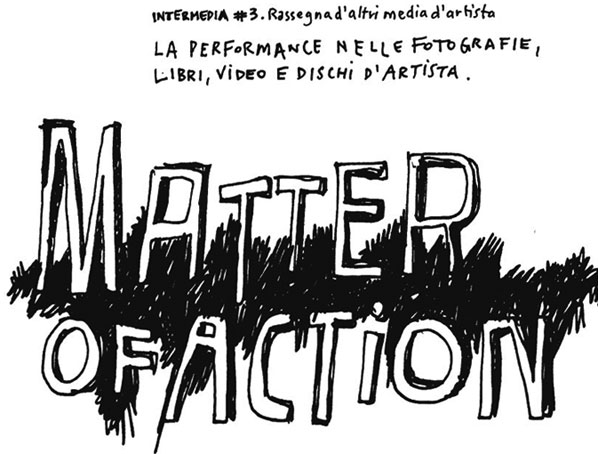
Matter of Action

Matter of Action is the third appointment of the INTERMEDIA cycle, an exhibition of alternative artist’s media - curated by Giorgio Maffei, Sara Serighelli, Fabio Carboni and Samuele Menin.
By nature, performance, happening, body art, action poetry are artistic actions aimed at lasting only for the short moment of their ritual fulfillment. This exhibition tries to stop the time focusing on the sequence of actions through those media able to give substance and duration to the performing event – photographs, records, videos and books. Through a set up that can appear disturbing, the exhibition wants to suggest a sharing experience of the contents based on the visitors’ perception.

Photographs, books, videos and the artist’s records hold the memories, preserving tracks and, at the same time, transcribing - with different tools - images, words and meanings of a way of making Art that has deeply affected the historical development of the second half of the 20th century.
All along the exhibition, art works from the 60s and 70s are gathered through necessary historical photographs to hint at the first performing actions of the Avant-garde and of the artists who, at the end of the ‘50s, turned their work toward the overtaking of the objectual form of the artifact. Duchamp, Man Ray, Dalí, then Manzoni with Klein and Fontana undertook the path which find its thoroughness both in the Conceptual and in the Arte Povera anvironment, as well as in Fluxus of the following decade. Allan Kaprow’s theorizations, Abramovic and Gina Pane’s actions, Nitsch and Muehl’s expressive violence, Acconci and Oppenheim’s body discipline, Ontani e Lüthi’s trasformism, Agnetti, De Dominicis and Nauman’s rigorous intellectual action, Kounellis and Calzolari’s theatrical behaviour, the use of their own face as expressive matter in Boetti, Penone and Zorio, and moreover, up to the overtaking of the disciplinary limits with the new music of Cage, Chiari and La Monte Young, the dance with Monk and Trisha Brown or poetry with Lora Totino, Spatola and Isou.

In a part of the exhibition Matter of Action, Italian artists have been invited to present in Milan a performance already made in their past, through two different ways: live performances with Italo Zuffi, Simone Berti, Giovanni Morbin, Christian Frosi & Diego Perrone, Dafne Boggeri, Nicola Ruben Montini, Michele Bazzana, Igor Muroni, as well as through some videos, with documents by Cesare Pietroiusti, Elisabetta Benassi, Lorenzo Scotto di Luzio, Cesare Viel, Patrick Tuttofuoco, Davide Savorani, Sissi (…). This part hasn’t the historical ambition to cover everything that has been happening in Italy during the last years, but it freely dots a temporal lapse through the actions of some artists who have occasionally or constantly used the performance in their research. These appointments draw possible trajectories and paths between historical experiences from the 60s and 70s up to contemporary episodes.

Over forty years after the publication of the text “Intermedia”(February 1966) by Dick Higgins in “The Something Else Newsletter”, the curators of this exhibition have borrowed this title which best expresses the need of contemporary culture to 'shuffle the cards,' to break down the strict barriers between disciplines and to consider art and its ways of expression as one singular creative process. The cycle of exhibitions develop through themes and segments: the first appointment of the cycle, ‘10 - a generation of artist's books, 1999-2009’ was held in September 2009 and the second ‘SUPERARCHITETTURA RADICALE books, posters, magazines’ in April 2010.

Performances:
venerdì/ Friday 11 feb. Nicola Ruben Montini
lunedì/Monday 14 feb. Igor Muroni
venerdì/ Friday 18 feb. Dafne Boggeri
lunedì/Monday 21 feb. Giovanni Morbin
venerdì/ Friday 25 feb. Michele Bazzana
lunedì/Monday 28 feb. Simone Berti
venerdì/ Frida y 4 mar. Diego Perrone & Christian Frosi
lunedì/Monday 7 mar. Italo Zuffi
All performances will be held at O’ via Pastrengo 12, Milano, 8.30 pm

Videos by: Moira Ricci, Cesare Pietroiusti, Giancarlo Norese, Luigi Negro, Emilio Fantin, Luigi Presicce, Cesare Viel, Nico Vascellari, Orthographe, Invernomuto, Giovanna Ricotta, Patrizio di Massimo, Sissi, Lorenzo Scotto di Luzio, Alessandro Ceresoli, Elisabetta Benassi, Alessandro Sciarroni, Patrick Tuttofuoco, Francesca Grilli, Michael Fliri, Davide Bertocchi, Paola Anziché, Marco Vaglieri, ZimmerFrei, Enzo Umbaca, Marcella Vanzo, Davide Savorani, Filippo Berta.

info:
O’, o AT o-artoteca DOT org
Giorgio Maffei, info AT giorgiomaffei DOT it

O'
via pastrengo 12, 20159 milano
www.on-o.org

January 15, 2011

Four Blindfolded Dialogues and Transcripts

Steve Piccolo, Milano
Mon, 6 Aug 2007 14:16:37

I’m writing this in English because I’m blindfolded and I can’t find the accents on the keyboard in Italain. This is the final segment of an hour spent in various sensory depraivation modes in an attempt to generate some kind of long distance psychich contact among our group. At first I was expecting a signal on Skype as plannned, but then I realized that the short text msg on the phone was the only hint to begin. I thought of Emilio and realized that was how he would do it. I put on my glasses with paper taped over the lenses. I thought a partial blindfold might resemble, more closely, the post-op condition of Luigi. A bit of peripheral vision, light that enters from the sides, not impossible to get oriented in a room, but impossible to actually do anything constructive. Or not?

I was holding my guitar when the experiment started so I began playing. Thirty minutes of so passed in a flash, the playing was long and slow and meandering, much more concentrated than usual, very patient about thematic development, returning again and again to growing patterns. I was playing for Luigi and for everyone who mighht be listening.

Then I realized that this was just too damn easy. For a musician, being deprived of sight is a boon, at least for playing. Just look at this text I have typed without ever removing the blindfold. I can’t see it, but I’m sure it has very very few mistakes. Myfingers can tell what is happening. There is probalbly a mistake near ‘fingers’, and probably another one near the start of this sentence.

I thought maybe I should try being deaf instead of blind. So I removed the blindfold. It was true, a half hour had passed. I found my super earplugs in the bathroom and stuffed them into my ears. Now it was possible to take a piss, to smoke a cigarette, all things I had been putting off because being sightless made them difficult. I thought about Luigi and realized that this solution was also too easy. So I put the papered bglasses back on. At this point I was semi-deaf and semi-blind. Void. Noresian silence. I wondered how Luigi manages to use the microtrack to make recordings if he can’t see. I know that machine very well, use it every day, I can even find it in the mess on my work table with my papered glasses on. So I tried recording something. It was nearly impossible.
Not enough audio feedback signals for the functions.
Even with earbuds instead of earplugs it wasn’tpossiblel to really get any work dpme.

Suddenly the time got endless. We were all just sitting there, I thought, Cesare, Luigi, Giancarlo, Emilio, me. Or lying down. I had set my mobile phone alarm so I’d know when the hour was up. Maybe it wasn’t working. Maybe I set it wrong.It seemedlike much more than an hour had passed. I could imagine the others, blindfoldied, mpo longer trying anything in particular, just resting or waiting for the end of the experiment. I knew they were doing that, but they might also have fallen asleep. After lucnch. I felt lonely. The visible objects around us keep us company, looking at them fills up time, adds a rhythm of references to things and when that rhythm is gone everything slows down.

I wondered if the others were really doing the experimnt or if I was the only one, sitting in my hot studio in Milan weeearing glasses with paper taped over the lense. So I saaat down at the computer and started writing these thoughts, before they vanished, like dreams in the morning. In the middle of the process the mobile phone alarm went off. The hour was up. In that split second something hit me. The body, the body detached from its surroundings by sensory closure. It wasn’t necessary but I put on a real blindfold and put the earplugs back in and concentrated on the image that was growing. It was a sexual fantasy, and in this blocked condition it was particularly vivid. The goddess smiled and told me that bodies can heal themselves especially when they know desire and cultivate it in union with other bodies. She beckoned to me, I reached out and caressed the column of hot air blowing out of the fan on my desk…

So in a way I blew it. The hour is up and finally, now, I have some positive energy to send. Hope it’s not too late.


Cesare Pietroiusti, New York
9 agosto 2007, 5.05

Dunque trascrivo gli appunti che ho preso subito dopo l'ora passato bendato. Contesto: ero a casa, alle 9 di mattina, Carolyn e Pinki dormivano. Ho usato una benda da aereo che non lasciava filtrare quasi niente di luce, comunque sono stato per lo più con gli occhi chiusi, salvo in un paio di occasioni in cui li ho aperti automaticamente, come risposta a un rumore improvviso.

Subito ho notato la lentezza dei movimenti e dei gesti e ho pensato che, a parità di tempo, si possono fare meno cose in tale condizione. Poi ho pensato al fatto che bisogna avere una maggiore attenzione alle proprie memorie a breve termine: bisogna ricordare dove si è appena lasciato il bicchiere, per esempio, per non rischiare di romperlo... è un po' come se tutte le "situazioni" pre-esistenti (oggetti, mobili, persone) debbano essere presenti alla memoria.

Ho notato l'importanza dei rumori che si producono: i passi sul pavimento, l'urto contro un oggetto, tutto contribuisce a dare informazioni sulla propria posizione e sui rischi che si stanno correndo, ma c'è anche un aspetto di puro e semplice piacere nel sentire i rumori che si producono abitualmente con una nuova intensità e precisione. A un certo punto ho acceso la radio e ho dovuto mettere il volume bassissimo, molto più basso del normale, perché la musica mi disturbava e mi confondeva (in genere mi succede il contrario).

Ho pensato che un appropriato sistema di segnali sonori associati a ogni oggetto, anche piccolo, di una casa, consentirebbe di muovercisi con la stessa velocità e precisione come se ci si vedesse. Le mani (in piccola parte anche i piedi) delimitano continuamente un "campo", fatto in genere di linee dritte o di angoli netti, in cui, momento per momento, ci si può muovere e si può agire: i punti di riferimento spaziali (la linea dritta di un armadio, l'angolo di un rivestimento sul muro) sono fondamentali e usati continuamente.

Ho avuto la sensazione di essere stato sempre presente a me stesso, in una specie di costante auto-osservazione, e che ci fosse un costante flusso di pensieri legati alla particolare situazione che veniva prodotto (e che, probabilmente, pensavo, non sarei stato in grado di recuperare...). Solo in un determinato momento (probabilmente verso il 40º minuto) ho abbandonato questa situazione di auto-osservazione e mi sono sentito "normale", non in condizione di deprivazione né in una situazione di esperimento.

Mi sembrava di avere molte idee, anche interessanti... ma non saprei dire quali fossero. Forse quella di fare l'ultima parte dell'intervento per S.C. "a distanza" dialogando con il pubblico in una qualche situazione di deprivazione tipo questa, per email.

La cosa che mi ha dato più fastidio è stata la confusione dentro il frigorifero (troppe cose, mescolate disordinatamente). Ho pensato che per chi ha problemi gravi di vista, è necessario un grande ordine e poche cose.

A un certo punto ho sentito qualcuno che si muoveva per casa e mi sono sentito un po' in imbarazzo (anche se tutti erano stati avvisati che avrei fatto questo esperimento). Però quello è stato l'unico momento in cui stavo per togliermi la benda. peraltro credo che il rumore che avevo sentito
provenisse da fuori.

Durante l'ora da bendato ho fatto colazione (latte di riso, pane abbrustolito con burro). Nonostante quello che mi aspettavo il senso del gusto non è affatto aumentato durante questa esperienza; al contrario, mi è sembrato di avere un gusto molto atrofico, e quasi di non essere in grado di sentire nemmeno che alcune parti della fetta di pane che avevo tostato erano, in effetti, bruciate.

Complessivamente però l'esperienza ha avuto degli evidenti caratteri "sensuali" – si sente l'aria, si sente molto di più tutto – con una discreta "erotizzazione" (diciamo così) del mio stato mentale dopo l'ora passata bendato.

In modo esplicito nessuno di voi mi è venuto in mente. Ho "visto" solo Luigi, due o tre volte, con degli occhiali a volte opachi, sempre accompagnato da una ragazza...


Giancarlo Norese, Novi Ligure
6 agosto 2007

un'ora bendati (tentativo di trasmissione del pensiero)

Paura (prima parola).
Fischiano tantissimo le orecchie.
Io + Luigi = un uomo morto.
Africa.

(Pausa, causa panico. Mi tolgo la benda e la rimetto)

Emilio: Mi sentite?
Giancarlo: OK.
Luigi: Nonostante il fischio... Potete capirmi meglio, ora.
Cesare: Debbo dire che è una condizione non male, per certi versi…
L.: Aspetta a dirlo, vedrai.
G.: Io mi sto cagando sotto…
E.: Devo dire che ha qualcosa di grottesco, questa condizione. Ma ditemi, voi che fate? Siete in piedi o seduti?
L.: Io a letto.
C.: In piedi, sto cercando di bere.
G.: Seduto, sto scrivendo di voi, a ciò che pensate.
E.: Anch'io sono in piedi.
C.: La cosa lampante è che i suoni assumono tutta un'altra dimensione, oserei dire inquietante.
E.: Sentite, posso chiedervi quale film avete visto ultimamente?
L.: Io nessuno…
C.: Io ho visto uno strano film di Antonioni fatto con un cinese e un altro tizio, "Eros".
G.: Io un magnifico film di Aldo Lado (che sembra uno che usa sempre le stesse lettere), degli anni 70; in francese si intitola "Je suis vivant", è la storia di uno in catalessi che cerca di ricordare il proprio passato ma che alla fine subisce un'autopsia, pur essendo ancora vivo.
E.: (incomprensibile)
L.: Direi che ha un po' a che fare con la nostra situazione: cercare di parlare senza avere la facoltà del linguaggio, isn't it?
C.: Come un trapezista senza trapezio.
Steve: Ehi, ci sono anch'io!
Maddalena: E pure io…
G.: Stavo giusto pensando alla tua voce che ci legge le storie del Cafausu…
S.: That's why you've heard something in English.

(Mi addormento. Alle 16 suona la sveglia)


Emilio Fantin, Bologna

Immagine centrale: siamo tutti riuniti vicino a un albero secco, vedo chiaramente tutti, una grande albero secco. Luigi ha i suoi occhiali da sole e sento la sua voce dire: non abbiamo trovato questa figura. Tutto intorno il deserto.
Inizio con questa immagine perché è l'unico momento in cui mi rendo conto di avere una visione non voluta, assolutamente imprevista (non sto sognando, sono perfettamente conscio); accade pressappoco a metà e dura pochissimo. Il resto del tempo mi sforzo di entrare nella testa di Luigi per assorbirne il dolore, l'inquietudine, la preoccupazione. Mi domando che cosa sia questo "gioco" rispetto alla sofferenza vera.

Inadeguato e insufficiente, così mi sento, ma porto il pensiero agli altri: Cesare, Giancarlo Steve e Luigi naturalmente. Il fatto di sapere che altri sono bendati come lo sono io mi consola e mi sembra di percepire una forza vera, composita, che spinge verso Luigi. Si agitano davanti a me forme nere su nero, fluttuanti. Poi mi acquieto e passo un periodo di transizione apparentemente senza trovare connessione alcuna. Ora ho un ago di una siringa che mi trafigge l'occhio, per sottrarmi a questa sensazione dondolo la testa a destra e a sinistra ma non passa così velocemente.

Usciti da questa situazione inquietante segue un nuovo un periodo di calma indifferente. Poi mi viene un colpo di sonno che combatto ributtandomi dentro la testa di Luigi e ascoltando l'emicrania (la sua). Mi rendo conto che a volte associo le persone a delle immagini che già conosco, come per esempio cesare che nell'appartamento di Manhattan siede semisdraiato vicino alla finestra. Si deve fare attenzione a separare le immagini della memoria (già vissute) con quelle che appaiono del tutto nuove.

Sono di due tipi diversi. Le prime sono legate alla conoscenza e ai rapporti avuti in precedenza con i partecipanti. È per questo che sento steve più lontano di gianca e cesare, forse perché non ho molte immagini da associargli. Durante tutto il tempo, a più riprese e a fasi alternate, ascolto la forza della condivisione tra noi cinque ma è allo stato istintivo e non riesco a selezionare le varie forze individuali. A un certo punto, credo verso la fine, sento la voce di qualcuno di noi (una voce metallica), non ricordo cosa dice, ma l'immagine che riflette è un rettangolo (uno schermo?) buio, nero.

Passa qualche istante e la voce di cinzia mi avverte che sono le quattro e dieci: sono sorpreso, pensavo di dovere restare al buio più a lungo, è già passata un'ora.  Sento il bisogno di comunicare subito quello che in me è ancora fresco e vivo. Ho la sensazione di avere ancora molte cose da dire ma non sono in superficie, mi manca l'altra parte di "noi", cioè voi, per acciuffarle.

January 4, 2011

Illustre Scultura Polimaterica. Il libro

Illustre Scultura Polimaterica. Il libro
A cura di Rita Correddu e Alice Militello
giovedì 27 gennaio 2011, ore 21
Librerie Coop Ambasciatori, via Orefici 19, Bologna

Presentazione del libro che documenta il progetto “Illustre Scultura Polimaterica” realizzato nel gennaio 2010 presso gli spazi del Link Associated.
L’incontro si pone quale momento per discutere insieme agli artisti Emilio Fantin, Luigi Negro, Giancarlo Norese e Cesare Pietroiusti, del processo di attuazione del lavoro.
La presentazione sarà accompagnata dalla proiezione di immagini di archivio. Dialoga con gli artisti Francesca Marianna Consonni, responsabile Dipartimento Educativo del Maga – Museo Arte Gallarate.

Progetto ArtePubblica

November 6, 2010

AND AND AND / Event 6 / Pilgrimage from Lu Cafausu

The Celebration of the Living (who reflect upon death). A pilgrimage from Lu Cafausu for AND AND AND, in the frame of dOCUMENTA (13), San Cesario di Lecce, Italy, Nov. 2, 2010.
Ph. Ayreen Anastas.

October 31, 2010

The Celebration of the Living (who reflect upon death)

For the sixth event, AND AND AND* has invited the Italian artist collective composed of Emilio Fantin, Luigi Negro, Giancarlo Norese and Cesare Pietroiusti. For the AND AND AND series, the artists - in collaboration with Luigi Presicce - propose to turn the November 2 traditional celebration of the Dead, into a new holiday: 'La Festa dei Vivi (che riflettono sulla more)', 'The Celebration of the Living (who reflect upon death)'. For this celebration, the artists want to invite those who are interested to be part of a pilgrimage, probably the shortest and slowest in the world, that will depart from its destination (rather than arriving to it), Lu Cafausu in San Cesario di Lecce.

Lu Cafausu is a mysterious small building, an architectural remnant that the artists have elected as a source of metaphors and narratives. It is 'an imaginary place that really exists' around which the presence of death is floating. Any day, the small building can in fact be demolished to accommodate more parking space for cars, or can also fall apart due to its precariousness. It could also be turned and frozen into a monument. Because of this feeling of the presence of death, Lu Cafausu is an ideal place for a new celebration. 'La Festa dei Vivi' is for those who, in order to give sense to life, reflect upon death; their own, 'first and foremost.'

Time: Tuesday November 2, 2010 - 10 am
Country: Italy
City: San Cesario di Lecce
Location: 40°18'1"N 18°9'43"E
Address: via C.F. Barbieri, 52

www.lucafausu.tk | www.documenta.de

*AND AND AND is an artist run initiative, which will use the time between now and dOCUMENTA (13) in 2012 to consider with individuals and groups across the world the role art and culture can play today and the constituent publics or communities, which could be addressed. The series of interventions, situations, and occurrences entitled AND AND AND are part of dOCUMENTA (13) and will compose a map of emergent positions, concerns, and possible points of solidarity.

AND AND AND
www.andandand.org