Showing posts with label Cesare Pietroiusti. Show all posts

February 12, 2016

New multiple: N, Artist’s Alphabet, Materia Multipli, Roma, IT, 2016

The project arises from a visit at Luca Pancrazzi’s studio in Milan in May 2015, but starts taking shape after summer break in mid september.
The ALPHABET consists of 26 letters (classical latin alphabet), each one interpreted by a different artist. The letters are printed in offset on white 130g Old Mill paper, A3 format, in 100 pieces signed and numbered on the back.

It is an open project meaning that in the future a letter may be reinterpreted by a different artist. There will be an exhibition including a catalogue featuring the first complete alphabet.

Materia, multipli d’artista, www.materiamultipli.com

Max Renkel, Karl Daubmann, Judith Kakon, Christof Nüssli, Marco Raparelli, Michaela Langenstein, Giorgio Di Noto, Simone Berti, Luca Pancrazzi, Jonathan Monk, David Schutter, Isabell Heimerdinger, Martin Soto Climent, Giancarlo Norese, Matteo Fato, Benjamin Hirte, Hilario Isola, Rä Di Martino, Stefania Galegati, Mikkel Carl, Cesare Pietroiusti, Kilian Rüthemann, Jinn Bronwen Lee, Elena El Asmar, Florian Graf, Alfredo Pirri.

September 25, 2015

Forum dell’arte contemporanea italiana 2015, Prato

Il Centro per l’Arte Contemporanea Luigi Pecci di Prato organizza il primo Forum dell’arte contemporanea italiana (25-26-27 settembre 2015), una tre giorni di dibattiti che coinvolgerà tutti gli operatori del settore, chiamati a Prato per fare il punto sulle criticità del “sistema arte in Italia” e sulle difficoltà per l’arte italiana ad affermarsi sul piano internazionale. 
Il Forum, che si avvale di un comitato promotore formato da Ilaria Bonacossa, Anna Daneri, Cesare Pietroiusti, Pier Luigi Sacco, insieme a Fabio Cavallucci, direttore del Centro Pecci, sarà strutturato in tavoli di lavoro formati da un coordinatore e da dieci relatori, che a partire da una serie di questioni e temi definiti cercheranno di elaborare nuove proposte e soluzioni.  

Il sito, vero e proprio spazio work in progress, rispecchia la natura processuale e relazionale del progetto, nel tentativo di accogliere suggerimenti, nuovi contenuti, temi e partecipanti che si uniranno nei giorni che ci separano dal Forum.

ph. G.N.
Il Teatro Metastasio è il quartier generale del Forum dove si svolgono le sessioni plenarie e gli interventi generali; Monash University e Palazzo Banci Buonamici ospitano i tavoli di lavoro. Le tematiche affrontate durante il Forum sono divise in sei macroaree: [F], [R], [A], [M], [S], [PP]. Ogni macroarea è formata da un gruppo di tavoli che lavorano in simultanea e affrontano i rispettivi argomenti seguendo una struttura fissa: criticità, obiettivi, proposte. Le relazioni conclusive dei coordinatori di ogni singolo tavolo sono esposte al pubblico e discusse al Teatro Metastasio. La giornata finale, domenica 27 settembre, dopo le relazioni della macroarea [S], è il momento delle conclusioni e delle sintesi.

/

Come rilanciare, in funzione creativa, immaginativa e di ricerca, la lingua italiana? In quali ambiti e in quali modi va riconosciuta l’indispensabilità della sua funzione e della sua ricchezza, non riducibile alla traduzione inglese?

26.09, ore 12.30

Coordina:

Partecipanti al tavolo:

September 7, 2014

I baffi del bambino, Milano

Lucie Fontaine is glad to present “I baffi del bambino” [the child’s moustaches] a project curated by Luca Bertolo. The exhibition opens on September 15, 2014, from 7 to 9 pm and it will remain on view until December 15, 2014.

Accompanied by the following text, the project includes works by Alis/Filliol, Riccardo Baruzzi, Luca Bertolo, Sergio Breviario, Chiara Camoni, canecapovolto, Bettina Carl, Radu Comşa, Flavio Favelli, Linda Fregni Nagler, Antonio Grulli, Paul Housley, Esther Kläs, Adriano Nasuti Wood, Giancarlo Norese & Cesare Pietroiusti, Katrin Plavcak, Alessandro Pessoli, Luigi Presicce, Fabrizio Prevedello, Autumn Ramsey, Antonio Rovaldi, Alessandra Spranzi and Italo Zuffi. Lucie Fontaine’s address is Via Rigola 1, Milan; it is open by appointment only. Please contact Lucie Fontaine’s employees at felix (at) luciefontaine (dot) com.


[lines deleted] ... in other words, a nicely curved shoulder is practical (and therefore handsome) while a sunken chest is not (and therefore unseemly). Who says so? Anatomy, Mechanics, and the Laws of Physics.[lines deleted]

Precisely twenty years ago, my friend Luca Giorcelli and I opened Risultati buoni1, a show of works done by four hands. We’d started from medical and veterinary pamphlets we’d found in abandoned rooms at the former Sierotherapy Institute in Milan. We’d taken photographs of certain images taken from books (dogs, horses, tools) and printed exploded views. We’d also monkeyed with the texts, deleting certain parts. The big attraction that lent the show its name was a series of semi-nude women (patients photographed following a hip operation) apparently caught in the act of performing absurd dance steps. An audio track completed the show: short bursts of birdsong accompanied by comments in Russian in a virile man’s voice. With the exception of our girlfriends and a few other friends we’d invited for the inauguration, that show – my very first – received no other visitors.

Contemplation is nothing more than an occasional lapse in that widespread and all-inclusive condition of always having to do some this or that, this and that.2

I purchased my first work of art, a painting, in 1993. I bought it right from the author, an older friend of mine, spending two thirds of what I had in the bank, the equivalent of today’s one thousand euros. The small beautiful canvas rather simply shows a man sitting. Slightly green against a slightly green backdrop. And just what is this slightly awkward man doing? Sitting. He’s evidently chosen a comfortable spot from which to view the world. Now as everyone knows, contemplation is an entirely peculiar activity, given that one’s attention is not focused as much on things as on what they mean. And as Byung-Chul Han3 explains, contemplation is by no means passive; it is, on the contrary, a form of activity of higher level, as well as a much-needed corrective to the somewhat hysterical form of activism (performance) that characterizes this moment in our history. But times are hard for contemplation and contemplators, even in the world of art, where the mere mention of the word suffices to get a roomful of people antsy.


To tell the truth, we’re all clumsy things ourselves. This burden, both detestable and heart-warming, represents our human condition only too well: creatures tottering between animality and culture, the pleasure principle and reality, body and spirit, approximation and fanatical perfectionism. And keeping balance is hardly easy. Particularly stimulating in a work of art, whenever I happen to find it, is the tension between elegance and awkwardness. It cheers me up no end. Also, as many of us have observed, certain gestures can be all the more expressive for their clumsiness. At any rate, ever since the world was born, artists, writers, scientists, and musicians have been bustling around forms attempting to create elegance and bring a bit of order to chaos. They try damnedly hard. That’s entirely understandable. The limit is reached when the form is so tight that all life gets smothered inside.

to repeat: it is the impossibility of eradicating entirely the "arbitrariness", except if one chooses the solution of the monochromes – and maybe not even then – that is at the base of our current mourning of modernism.4

At a distance, I think this show also has something to do (again? perhaps so...) with the so-called death of utopias. Organizing the perfect society, building the new Man – these are the sublime aberrations we’re talking about. Humanity doesn’t really seem to have had much luck with socio-political planning so far. Sooner or later some glitch or side-effect comes up, like gulags. Modernism was another expression of that same exasperated idealism, if but with less horrible consequences. One way or another, Modernist diktats have been safely removed to the attic for some time now. So why, in fact, should any monochrome be deemed more pure than a wanderer looking over a sea of fog?

Here’s the bottom line: what I’m about to say may appear off the subject or at least at odds with what I’ve said above. Bear with me: despite all his fragility, the child commands. Ruthless hunter of lizards, candid self-accuser, powerful improviser – that’s a child. For an adult, the child is a counter-study. And if that’s the case, he can even have a moustache5. A child is a lake an adult can tap for moisture whenever he feels dried up. A child stumbles and trips again, drawing benevolent smiles from adults: he is the one who will be looking after his forefathers.
L.B., March-August 2014


1. The show was held at Circolo Culturale Index in Milan.
2. Carlo Sini, "Alle radici ancestrali del disegno", in Il disegno dopo il disegno, Pisa University Press, 2013.
3. Byung.Chul Han, Die Müdigkeitsgesellschaft (Fatigue Society), 2010.
4. Yve-Alain Bois, Painting as Model, MIT Press, 1990.
5. See Il bambino con i baffi, “acoustic film” by canecapovolto, a work on display in this show.

(translation by Craig Allen)
Ph. by Oak Seed Studio, Courtesy Lucie Fontaine


Lucie Fontaine
via Rinaldo Rigola, 1
20159 Milano
www.luciefontaine.com

August 8, 2013

the archive of forgotten ideas

Sometimes we have ideas that we like but for rational, emotional or practical reasons we think they won’t work out or we aren’t able to develop them at that moment. Consequently we keep them apart, “hide” them somewhere in a peripheral and little attended side of the memory. We use some of them while, through the passage of time, we forget others.

Cecilia Guida asked artists, intellectuals, writers, scientists, economists, etc. to remember an (apparently) forgotten idea and transferred the intuitions and incomplete ideas told to her, into this book.
The ideas are presented in chronological order – relative to the day when they were remembered – and a classifying principle. The archive is both the support and the place that marks the passage of ideas from private to public, from the sphere of the secret to the non-secret. Thus, alongside each idea the e-mail contact of its author is specified, so that every time the archive is shown or exhibited, exchanges of opinions can happen and new collaborations to turn un-used ideas into real projects can be created.

Cecilia Guida (ed. by):
"the archive of forgotten ideas."
Including contributions by 42 authors
42 pages, 14.8x21 cm
b/w digital, color cover
English/Italian with some Spanish
First edition, August 2013:
140 copies, unnumbered.

Texts by Armona Pistoletto, Diego Del Pozo Barriuso, Natalia Gil Medina, Francesco Bernabei, Cesare Pietroiusti, Anne Calas, Alain Lafuente, Davide Borrelli, Emilia Telese, Giancarlo Norese, Mikolaj Lozinski, Jakub Wrzesniewski, Asiya Wadud, Annunziata Sgura, Giuseppe Semeraro, Bona Park, Jacopo Miliani, Steve Piccolo, Margarita Vasquez Ponte, Charlotte Cole, Wu Ming 1, David Behar Perahia, Marcela Ceballos Gonzalez, Saioa Olmo Alonso, Julia Staniszewska, Daria Filardo, Dark0, Diego Bonetto, Beatrice Catanzaro, Viviana Gravano, Anteo Radovan, Roberta Mosca, Antonio Rafele, Stefano Cristante, Kruder&Pardeller, Ermanno Cristini, Andrea Lanza, Anna Franceschini, Silvia Bottiroli, Cesare Viel, Luca Scarabelli, Alberto Abruzzese.

available on bigcartel.com

a certain number of books.

January 10, 2013

Tenkalaut, Rabat

Tenkalaut, Istituto Italiano di Cultura, Rabat
Jeudi 10 janvier 2013 à partir de 18 heures
Patio de l’Institut Culturel Italien de Rabat
Performance de Giancarlo Norese, inspirée du livre “Tenkalaut. Seven dialogues between Giancarlo Norese and Cesare Pietroiusti”.

Performance participative dans le cadre de Traduction Tradition Trahison, un projet /résidence et exposition qui s’inaugure le 9 janvier 18H30 au Cube Indipendent Art Room de RABAT

Le projet a été réalisé avec le soutien de l’Istituto Italiano di Cultura , Le Cube indipendent Art room et AECID (Agencia Española de Cooperación Internacional para el Desarrollo) /Ambassade d’Espagne à Rabat. 

Istituto Italiano di Cultura
2 bis, av. Ahmed El Yazidi, Rabat

October 27, 2011

The Celebration of the Living 2, Venezia/Lecce

The Patience Sanctuary in San Cesario di Lecce

MICROCLIMA and LU CAFAUSU present
The “Celebration of the living (who reflect upon death)”, 2011 (second edition)
A sculpture workshop, a trip, a conference, a celebration.

Between October 30th and November 3rd the second edition of the “Celebration of the living (who reflect upon death)”. This edition will be articulated in the form of a complex workshop which will take place in the Serra dei Giardini in Venice, in San Cesario di Lecce, and on the bus between the two places. The celebration is a project by Emilio Fantin, Luigi Negro, Giancarlo Norese, Cesare Pietroiusti and Luigi Presicce.

The steps of the workshop are the following:

VENICE
Oct 30 and 31, sculpture workshop at the Serra dei Giardini: all the participants, individually or in small groups, will reproduce Polipo (Octopus) a sculpture made by Ezechiele Leandro taken from the sculpture garden “Santuario della pazienza” (Patience Sanctuary). Once the sculptures are made, the participants will discuss and decide their further destiny.

During the workshop several events will take place, that are open to the public, among which:

Oct 30, 2011, 5 pm Monologues interpreted by Jacopo De Santis. Texts by Brocchi, Gaber, Laforgue, Maupassant, Pirandello, Zola.

Oct 31, 2011, 5 pm Gabriele Mina, anthropologist, editor of the book Costruttori di Babele. Sulle tracce di architetture fantastiche e universi irregolari in Italia, Elèuthera 2011, will present his research on artistic sites in Italy created by outsider artists. Microclima - Serra dei Giardini, Viale Giuseppe Garibaldi, 1254, 30122 Venezia - Castello
info(at)microclima-venezia.com
www.microclima-venezia.com

Nov 1 (only for the participants to the workshop) – bus trip from Venice to San Cesario di Lecce (approximately 12 hours); on the bus a conference with interventions by the participants on the themes related to the celebration will take place.

SAN CESARIO DI LECCE
Nov 2 – public celebration of the “Festa dei Vivi (che riflettono sulla morte)” and possible installation of the sculptures. Morning: Visit to Lu Cafausu and to the Santuario della Pazienza.
From 8.30 to 11.30 pm, in the Laboratorio di Arte e Architettura “Archiviazioni”, in Lecce, via Enzo Ferrari, contrada Pisello, Night party and cafausic happening with music from an almost forgotten Italian repertoire, curated by Oh Petroleum and Luca F.

Last year, on November 2, 2010, AND AND AND* has invited Emilio Fantin, Luigi Negro, Giancarlo Norese and Cesare Pietroiusti and Luigi Presicce and they have proposed to turn the November 2 traditional celebration of the Dead ones, into a new holiday: “La Festa dei Vivi (che riflettono sulla morte)”, “The Celebration of the Living (who reflect upon death)”.

For this celebration, the artists invited everyone to be part of a pilgrimage, probably the shortest and slowest in the world, having as a departure point and as its destination, Lu Cafausu in San Cesario di Lecce. The celebration and the pilgrimage wanted to represent a reflection upon death as transformation, threshold, mystery, but also as a necessary perspective of meaning.
The pilgrimage was also the occasion for a visit to the “Sanctuary of Patience” and an homage to the figure of Ezechiele Leandro.

Lu Cafausu is a mysterious small building, an architectural remnant that the artists have elected as a source of metaphors and narratives. It is “an imaginary place that really exists” around which the presence of death is floating. Any day, the small building can in fact be demolished to accommodate more parking space for cars, or can also fall apart due to its precariousness. It could also be turned and frozen into a monument.
Because of this feeling of the presence of death, Lu Cafausu is an ideal place for a new celebration, “La Festa dei Vivi”, who, in order to give sense to life, reflect upon death; their own, first and foremost. www.lucafausu.tk

The Santuario della Pazienza by Ezechiele Leandro (1905-1981) is an extraordinary example of mystical garden, a forest of statues, a temple or a cemetery, an almost unrepresentable site of the artistic power and expression of a self-taught dilettante artist, a singularity completely out of the grids and schemes that define and separate high and low culture. 


* ANDANDAND is an artist run initiative, which is using the time between now and dOCUMENTA (13) in 2012 to consider with individuals and groups across the world the role art and culture can play today and the constituent publics or communities which could be addressed.

March 21, 2011

Archiviazioni

Archiviazioni. 
Exercises of investigation and discussion on contemporary South

March 26th, 2011 - laboratory for Art and Architecture
via Enzo Ferrari, contrada Pisello, Lecce, IT


Actions:
Costruire Processi: progettualità, spazio e tempo / Building Processes: planning, space and time
public discussion, 11am–1pm and 3pm-5pm
with Julia Draganovic / Francesco Arena / Fabio Pollice and Annalisa Zacheo / Karen Hough / Devrim Kadirbeyoglu / Federica La Paglia / Attila Bruni / Shawn Van Sluys / Stefano Taccone / Chiara Agnello / Giulia Pedace / Mauro Marino / Francesca Boenzi

Gran Turismo / Great Tourism
curatorial revisitation of a private archive by Luigi Presicce and Luigi Negro / 18.00

Le Cose Preziose / The Precious Things
self-financing group action / 6.30pm
works of: Luigi Presicce, Francesco Arena, Luigi Negro, Luca Francesconi, Enzo Umbaca, Cristian Chironi, Stefano Romano, Paola Anziché, Daniele Pezzi, Andrea Kvas, Antonio Rovaldi, Angelo Bianco, Roberto Martino, Marco Belfiore, Adriano Nasuti Wood, Elenia De Pedro, Giorgio Guidi, Dragana Sapanjos, Stefano Graziani, Giallo Concialdi, Andrea Sala, Riccardo Beretta, Alessandro Ceresoli, Jacopo Casadei, Cesare Pietroiusti, Sergio Breviario, Alessandro Vizzini, Riccardo Baruzzi, Giancarlo Norese.

An autonomous society is different than a heteronomous one (hetero = others) because while all societies make their own imaginaries (institutions, laws, traditions, beliefs and behaviors), autonomous societies are those in which their members are aware of this fact, and explicitly self-institute (αυτο-νομούνται). In contrast, the members of heteronomous societies attribute their imaginaries to some extra-social authority (i.e. God, ancestors, historical necessity). Cornelious Castoriadis, Figures of the Thinkable, Stanford University Press, July 18, 2007

On the occasion of its public presentation, archiviazioni has invited Stefanos Tsivopoulos to elaborate an archive image which represents the main concept and the aims of the project. I Want My Utopia Back is a reflection on the concept of Autonomy in relation to that of Archiving as an action. This transformative process that goes from information to knowledge, from institutional construction to social action and the formation of an autonomous consciousness, was also the basis of democracy in ancient Greece. For Tsivopoulos, archives do not necessarily server as ‘representatives’ of the historical truth, but rather as another way to tell a story. This story aims to reflect the creative and imaginary possibilities of our times. Stefanos Tsivopoulos (Prague, 1973) is a Greek artist/filmmaker who lives and works in Athens and Amsterdam. His research reflects on history and historical memory as a narrative construction – a construction mediated by images that have been edited and re-edited, and deprived from images that were never taken or that are lost. In his films he is blurring fact and fiction, past and future, as he is less interested in extracting the truth from these narrative constructions, but rather in interrogating the possibilities and qualities that lie within them. It is the ambiguous nature of image, and its shift from an aesthetic object, to commodity to archived evidence of historical truth that is on question in his work.

archiviazioni – exercises of investigation and discussion on the contemporary South is an open project of documentation, discussion and action conceived and directed by Giusy Checola and curated together with Luigi Presicce, developed in collaboation with Salvatore Baldi for the production, Anna Cirignola and Elvira De Masi for the relations of the territory. It’s included in the program Lab 12:00 promoted by the SoutHeritage Foundation for contemporary art of Matera (Basilicata, Italy). It presents its activities and its spaces on the 26th March 2011 at its venue, the Laboratory of Art and Architecture of Lecce (Apulia, Italy), an ex tobacco factory based in the heart of Salento.


Archivica

Archivica is an archive in progress that selects and presents national and international art and interdisciplinary publications and reviews, the digital and audiovisual documentation of works and projects by artists, curators and theoricians from local, national and international fields, and in the so called ‘Souths’ of the world. With them Archivica establishes different kind of interactions and collaborations, through the collection of materials, the organizations and co-production of projects, the acquisition of meaningfull Funds for the relation between art and territory.

Archivica has acquired the personal archives of art critic Anna Cirignola, the Fondo Verri Liberi Cantieri of Lecce and the archives of Oreste by Cesare Pietroiusti, Luigi Negro, Emilio Fantin and Giancarlo Norese, including photos, letters, drawings, publications and printed matters produced during the activities of the Oreste Project, from 1997 to 2002.
Archivica has started a long term collaboration with careof/DOCVA Documentation Center for the Visual Arts in Milan, through the exchange of materials, for the promotion of the Southern artistic scene and the collection of untraceable videodocumentation of talks, seminars and projects realized in Italy and abroad by careof in the last twenty years, and through the development of projects of communication and presentation of the materials archived.
It has started various collaborations with projects, archives and art organizations like Expòsito, Observatory for Young Artists, Naples; Index, list of contemporary art in Basilicata promoted by the SoutHeritage Foundation, Matera; Connecting Cultures, Milan, specialized on art projects in the public spaces in relation with the landscape; ESCORIA Nuevos Medios of Quito, the most important archives in Ecuador, specialized in video-art and new media.

Archiviazioni is addressed to artists, curators, cultural operators and students who live and work in Southern Italy, and to everyone who wants to participate to the proposed activities. From here comes the collaboration with SUM Project of Lecce, a network for promotion of independent local music and local reference for the Creative Commons licenses, under which are registered the contents of the website archiviazioni.org, in order to stimulate the access to information and the free circulation of ideas.


info: www.archiviazioni.org / giusy AT archiviazioni DOT org

January 31, 2011

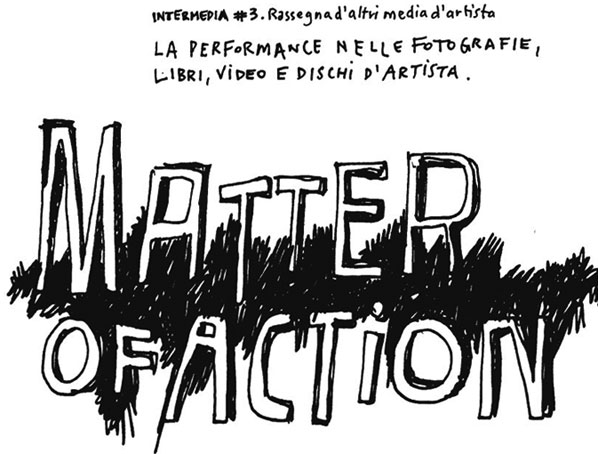
Matter of Action

Matter of Action is the third appointment of the INTERMEDIA cycle, an exhibition of alternative artist’s media - curated by Giorgio Maffei, Sara Serighelli, Fabio Carboni and Samuele Menin.
By nature, performance, happening, body art, action poetry are artistic actions aimed at lasting only for the short moment of their ritual fulfillment. This exhibition tries to stop the time focusing on the sequence of actions through those media able to give substance and duration to the performing event – photographs, records, videos and books. Through a set up that can appear disturbing, the exhibition wants to suggest a sharing experience of the contents based on the visitors’ perception.

Photographs, books, videos and the artist’s records hold the memories, preserving tracks and, at the same time, transcribing - with different tools - images, words and meanings of a way of making Art that has deeply affected the historical development of the second half of the 20th century.
All along the exhibition, art works from the 60s and 70s are gathered through necessary historical photographs to hint at the first performing actions of the Avant-garde and of the artists who, at the end of the ‘50s, turned their work toward the overtaking of the objectual form of the artifact. Duchamp, Man Ray, Dalí, then Manzoni with Klein and Fontana undertook the path which find its thoroughness both in the Conceptual and in the Arte Povera anvironment, as well as in Fluxus of the following decade. Allan Kaprow’s theorizations, Abramovic and Gina Pane’s actions, Nitsch and Muehl’s expressive violence, Acconci and Oppenheim’s body discipline, Ontani e Lüthi’s trasformism, Agnetti, De Dominicis and Nauman’s rigorous intellectual action, Kounellis and Calzolari’s theatrical behaviour, the use of their own face as expressive matter in Boetti, Penone and Zorio, and moreover, up to the overtaking of the disciplinary limits with the new music of Cage, Chiari and La Monte Young, the dance with Monk and Trisha Brown or poetry with Lora Totino, Spatola and Isou.

In a part of the exhibition Matter of Action, Italian artists have been invited to present in Milan a performance already made in their past, through two different ways: live performances with Italo Zuffi, Simone Berti, Giovanni Morbin, Christian Frosi & Diego Perrone, Dafne Boggeri, Nicola Ruben Montini, Michele Bazzana, Igor Muroni, as well as through some videos, with documents by Cesare Pietroiusti, Elisabetta Benassi, Lorenzo Scotto di Luzio, Cesare Viel, Patrick Tuttofuoco, Davide Savorani, Sissi (…). This part hasn’t the historical ambition to cover everything that has been happening in Italy during the last years, but it freely dots a temporal lapse through the actions of some artists who have occasionally or constantly used the performance in their research. These appointments draw possible trajectories and paths between historical experiences from the 60s and 70s up to contemporary episodes.

Over forty years after the publication of the text “Intermedia”(February 1966) by Dick Higgins in “The Something Else Newsletter”, the curators of this exhibition have borrowed this title which best expresses the need of contemporary culture to 'shuffle the cards,' to break down the strict barriers between disciplines and to consider art and its ways of expression as one singular creative process. The cycle of exhibitions develop through themes and segments: the first appointment of the cycle, ‘10 - a generation of artist's books, 1999-2009’ was held in September 2009 and the second ‘SUPERARCHITETTURA RADICALE books, posters, magazines’ in April 2010.

Performances:
venerdì/ Friday 11 feb. Nicola Ruben Montini
lunedì/Monday 14 feb. Igor Muroni
venerdì/ Friday 18 feb. Dafne Boggeri
lunedì/Monday 21 feb. Giovanni Morbin
venerdì/ Friday 25 feb. Michele Bazzana
lunedì/Monday 28 feb. Simone Berti
venerdì/ Frida y 4 mar. Diego Perrone & Christian Frosi
lunedì/Monday 7 mar. Italo Zuffi
All performances will be held at O’ via Pastrengo 12, Milano, 8.30 pm

Videos by: Moira Ricci, Cesare Pietroiusti, Giancarlo Norese, Luigi Negro, Emilio Fantin, Luigi Presicce, Cesare Viel, Nico Vascellari, Orthographe, Invernomuto, Giovanna Ricotta, Patrizio di Massimo, Sissi, Lorenzo Scotto di Luzio, Alessandro Ceresoli, Elisabetta Benassi, Alessandro Sciarroni, Patrick Tuttofuoco, Francesca Grilli, Michael Fliri, Davide Bertocchi, Paola Anziché, Marco Vaglieri, ZimmerFrei, Enzo Umbaca, Marcella Vanzo, Davide Savorani, Filippo Berta.

info:
O’, o AT o-artoteca DOT org
Giorgio Maffei, info AT giorgiomaffei DOT it

O'
via pastrengo 12, 20159 milano
www.on-o.org

January 15, 2011

Four Blindfolded Dialogues and Transcripts

Steve Piccolo, Milano
Mon, 6 Aug 2007 14:16:37

I’m writing this in English because I’m blindfolded and I can’t find the accents on the keyboard in Italain. This is the final segment of an hour spent in various sensory depraivation modes in an attempt to generate some kind of long distance psychich contact among our group. At first I was expecting a signal on Skype as plannned, but then I realized that the short text msg on the phone was the only hint to begin. I thought of Emilio and realized that was how he would do it. I put on my glasses with paper taped over the lenses. I thought a partial blindfold might resemble, more closely, the post-op condition of Luigi. A bit of peripheral vision, light that enters from the sides, not impossible to get oriented in a room, but impossible to actually do anything constructive. Or not?

I was holding my guitar when the experiment started so I began playing. Thirty minutes of so passed in a flash, the playing was long and slow and meandering, much more concentrated than usual, very patient about thematic development, returning again and again to growing patterns. I was playing for Luigi and for everyone who mighht be listening.

Then I realized that this was just too damn easy. For a musician, being deprived of sight is a boon, at least for playing. Just look at this text I have typed without ever removing the blindfold. I can’t see it, but I’m sure it has very very few mistakes. Myfingers can tell what is happening. There is probalbly a mistake near ‘fingers’, and probably another one near the start of this sentence.

I thought maybe I should try being deaf instead of blind. So I removed the blindfold. It was true, a half hour had passed. I found my super earplugs in the bathroom and stuffed them into my ears. Now it was possible to take a piss, to smoke a cigarette, all things I had been putting off because being sightless made them difficult. I thought about Luigi and realized that this solution was also too easy. So I put the papered bglasses back on. At this point I was semi-deaf and semi-blind. Void. Noresian silence. I wondered how Luigi manages to use the microtrack to make recordings if he can’t see. I know that machine very well, use it every day, I can even find it in the mess on my work table with my papered glasses on. So I tried recording something. It was nearly impossible.
Not enough audio feedback signals for the functions.
Even with earbuds instead of earplugs it wasn’tpossiblel to really get any work dpme.

Suddenly the time got endless. We were all just sitting there, I thought, Cesare, Luigi, Giancarlo, Emilio, me. Or lying down. I had set my mobile phone alarm so I’d know when the hour was up. Maybe it wasn’t working. Maybe I set it wrong.It seemedlike much more than an hour had passed. I could imagine the others, blindfoldied, mpo longer trying anything in particular, just resting or waiting for the end of the experiment. I knew they were doing that, but they might also have fallen asleep. After lucnch. I felt lonely. The visible objects around us keep us company, looking at them fills up time, adds a rhythm of references to things and when that rhythm is gone everything slows down.

I wondered if the others were really doing the experimnt or if I was the only one, sitting in my hot studio in Milan weeearing glasses with paper taped over the lense. So I saaat down at the computer and started writing these thoughts, before they vanished, like dreams in the morning. In the middle of the process the mobile phone alarm went off. The hour was up. In that split second something hit me. The body, the body detached from its surroundings by sensory closure. It wasn’t necessary but I put on a real blindfold and put the earplugs back in and concentrated on the image that was growing. It was a sexual fantasy, and in this blocked condition it was particularly vivid. The goddess smiled and told me that bodies can heal themselves especially when they know desire and cultivate it in union with other bodies. She beckoned to me, I reached out and caressed the column of hot air blowing out of the fan on my desk…

So in a way I blew it. The hour is up and finally, now, I have some positive energy to send. Hope it’s not too late.


Cesare Pietroiusti, New York
9 agosto 2007, 5.05

Dunque trascrivo gli appunti che ho preso subito dopo l'ora passato bendato. Contesto: ero a casa, alle 9 di mattina, Carolyn e Pinki dormivano. Ho usato una benda da aereo che non lasciava filtrare quasi niente di luce, comunque sono stato per lo più con gli occhi chiusi, salvo in un paio di occasioni in cui li ho aperti automaticamente, come risposta a un rumore improvviso.

Subito ho notato la lentezza dei movimenti e dei gesti e ho pensato che, a parità di tempo, si possono fare meno cose in tale condizione. Poi ho pensato al fatto che bisogna avere una maggiore attenzione alle proprie memorie a breve termine: bisogna ricordare dove si è appena lasciato il bicchiere, per esempio, per non rischiare di romperlo... è un po' come se tutte le "situazioni" pre-esistenti (oggetti, mobili, persone) debbano essere presenti alla memoria.

Ho notato l'importanza dei rumori che si producono: i passi sul pavimento, l'urto contro un oggetto, tutto contribuisce a dare informazioni sulla propria posizione e sui rischi che si stanno correndo, ma c'è anche un aspetto di puro e semplice piacere nel sentire i rumori che si producono abitualmente con una nuova intensità e precisione. A un certo punto ho acceso la radio e ho dovuto mettere il volume bassissimo, molto più basso del normale, perché la musica mi disturbava e mi confondeva (in genere mi succede il contrario).

Ho pensato che un appropriato sistema di segnali sonori associati a ogni oggetto, anche piccolo, di una casa, consentirebbe di muovercisi con la stessa velocità e precisione come se ci si vedesse. Le mani (in piccola parte anche i piedi) delimitano continuamente un "campo", fatto in genere di linee dritte o di angoli netti, in cui, momento per momento, ci si può muovere e si può agire: i punti di riferimento spaziali (la linea dritta di un armadio, l'angolo di un rivestimento sul muro) sono fondamentali e usati continuamente.

Ho avuto la sensazione di essere stato sempre presente a me stesso, in una specie di costante auto-osservazione, e che ci fosse un costante flusso di pensieri legati alla particolare situazione che veniva prodotto (e che, probabilmente, pensavo, non sarei stato in grado di recuperare...). Solo in un determinato momento (probabilmente verso il 40º minuto) ho abbandonato questa situazione di auto-osservazione e mi sono sentito "normale", non in condizione di deprivazione né in una situazione di esperimento.

Mi sembrava di avere molte idee, anche interessanti... ma non saprei dire quali fossero. Forse quella di fare l'ultima parte dell'intervento per S.C. "a distanza" dialogando con il pubblico in una qualche situazione di deprivazione tipo questa, per email.

La cosa che mi ha dato più fastidio è stata la confusione dentro il frigorifero (troppe cose, mescolate disordinatamente). Ho pensato che per chi ha problemi gravi di vista, è necessario un grande ordine e poche cose.

A un certo punto ho sentito qualcuno che si muoveva per casa e mi sono sentito un po' in imbarazzo (anche se tutti erano stati avvisati che avrei fatto questo esperimento). Però quello è stato l'unico momento in cui stavo per togliermi la benda. peraltro credo che il rumore che avevo sentito
provenisse da fuori.

Durante l'ora da bendato ho fatto colazione (latte di riso, pane abbrustolito con burro). Nonostante quello che mi aspettavo il senso del gusto non è affatto aumentato durante questa esperienza; al contrario, mi è sembrato di avere un gusto molto atrofico, e quasi di non essere in grado di sentire nemmeno che alcune parti della fetta di pane che avevo tostato erano, in effetti, bruciate.

Complessivamente però l'esperienza ha avuto degli evidenti caratteri "sensuali" – si sente l'aria, si sente molto di più tutto – con una discreta "erotizzazione" (diciamo così) del mio stato mentale dopo l'ora passata bendato.

In modo esplicito nessuno di voi mi è venuto in mente. Ho "visto" solo Luigi, due o tre volte, con degli occhiali a volte opachi, sempre accompagnato da una ragazza...


Giancarlo Norese, Novi Ligure
6 agosto 2007

un'ora bendati (tentativo di trasmissione del pensiero)

Paura (prima parola).
Fischiano tantissimo le orecchie.
Io + Luigi = un uomo morto.
Africa.

(Pausa, causa panico. Mi tolgo la benda e la rimetto)

Emilio: Mi sentite?
Giancarlo: OK.
Luigi: Nonostante il fischio... Potete capirmi meglio, ora.
Cesare: Debbo dire che è una condizione non male, per certi versi…
L.: Aspetta a dirlo, vedrai.
G.: Io mi sto cagando sotto…
E.: Devo dire che ha qualcosa di grottesco, questa condizione. Ma ditemi, voi che fate? Siete in piedi o seduti?
L.: Io a letto.
C.: In piedi, sto cercando di bere.
G.: Seduto, sto scrivendo di voi, a ciò che pensate.
E.: Anch'io sono in piedi.
C.: La cosa lampante è che i suoni assumono tutta un'altra dimensione, oserei dire inquietante.
E.: Sentite, posso chiedervi quale film avete visto ultimamente?
L.: Io nessuno…
C.: Io ho visto uno strano film di Antonioni fatto con un cinese e un altro tizio, "Eros".
G.: Io un magnifico film di Aldo Lado (che sembra uno che usa sempre le stesse lettere), degli anni 70; in francese si intitola "Je suis vivant", è la storia di uno in catalessi che cerca di ricordare il proprio passato ma che alla fine subisce un'autopsia, pur essendo ancora vivo.
E.: (incomprensibile)
L.: Direi che ha un po' a che fare con la nostra situazione: cercare di parlare senza avere la facoltà del linguaggio, isn't it?
C.: Come un trapezista senza trapezio.
Steve: Ehi, ci sono anch'io!
Maddalena: E pure io…
G.: Stavo giusto pensando alla tua voce che ci legge le storie del Cafausu…
S.: That's why you've heard something in English.

(Mi addormento. Alle 16 suona la sveglia)


Emilio Fantin, Bologna

Immagine centrale: siamo tutti riuniti vicino a un albero secco, vedo chiaramente tutti, una grande albero secco. Luigi ha i suoi occhiali da sole e sento la sua voce dire: non abbiamo trovato questa figura. Tutto intorno il deserto.
Inizio con questa immagine perché è l'unico momento in cui mi rendo conto di avere una visione non voluta, assolutamente imprevista (non sto sognando, sono perfettamente conscio); accade pressappoco a metà e dura pochissimo. Il resto del tempo mi sforzo di entrare nella testa di Luigi per assorbirne il dolore, l'inquietudine, la preoccupazione. Mi domando che cosa sia questo "gioco" rispetto alla sofferenza vera.

Inadeguato e insufficiente, così mi sento, ma porto il pensiero agli altri: Cesare, Giancarlo Steve e Luigi naturalmente. Il fatto di sapere che altri sono bendati come lo sono io mi consola e mi sembra di percepire una forza vera, composita, che spinge verso Luigi. Si agitano davanti a me forme nere su nero, fluttuanti. Poi mi acquieto e passo un periodo di transizione apparentemente senza trovare connessione alcuna. Ora ho un ago di una siringa che mi trafigge l'occhio, per sottrarmi a questa sensazione dondolo la testa a destra e a sinistra ma non passa così velocemente.

Usciti da questa situazione inquietante segue un nuovo un periodo di calma indifferente. Poi mi viene un colpo di sonno che combatto ributtandomi dentro la testa di Luigi e ascoltando l'emicrania (la sua). Mi rendo conto che a volte associo le persone a delle immagini che già conosco, come per esempio cesare che nell'appartamento di Manhattan siede semisdraiato vicino alla finestra. Si deve fare attenzione a separare le immagini della memoria (già vissute) con quelle che appaiono del tutto nuove.

Sono di due tipi diversi. Le prime sono legate alla conoscenza e ai rapporti avuti in precedenza con i partecipanti. È per questo che sento steve più lontano di gianca e cesare, forse perché non ho molte immagini da associargli. Durante tutto il tempo, a più riprese e a fasi alternate, ascolto la forza della condivisione tra noi cinque ma è allo stato istintivo e non riesco a selezionare le varie forze individuali. A un certo punto, credo verso la fine, sento la voce di qualcuno di noi (una voce metallica), non ricordo cosa dice, ma l'immagine che riflette è un rettangolo (uno schermo?) buio, nero.

Passa qualche istante e la voce di cinzia mi avverte che sono le quattro e dieci: sono sorpreso, pensavo di dovere restare al buio più a lungo, è già passata un'ora.  Sento il bisogno di comunicare subito quello che in me è ancora fresco e vivo. Ho la sensazione di avere ancora molte cose da dire ma non sono in superficie, mi manca l'altra parte di "noi", cioè voi, per acciuffarle.

April 28, 2010

Souvenir d’Italie. A nonprofit art story

Viafarini DOCVA è lieta di annunciare che dal 14 al 16 maggio partecipa alla seconda edizione del festival degli spazi indipendenti No Soul For Sale – a festival of independents, che dopo il successo registrato a New York l’anno scorso, si trasferisce a Londra, nei monumentali spazi della Turbine Hall della Tate Modern.

In questa occasione Viafarini presenta in anteprima Souvenir d’Italie. A nonprofit art story, una pubblicazione edita da Mousse Publishing, che vuole raccontare la storia e i protagonisti del mondo dell’arte contemporanea in Italia dal 1991 ad oggi, letti attraverso le lenti della storica realtà nonprofit italiana. Una raccolta di testimonianze, documenti, immagini e testi inediti che si articola in 17 capitoli.

Sabato 15 maggio, alle ore 16.30, all’intero dell’area predisposta sul piano rialzato della Turbine Hall, ci sarà la presentazione del libro, unitamente a una bizzarra lotteria di un’altra tipologia di Souvenir d’Italie.

No Soul For Sale, concepito da Maurizio Cattelan, Cecilia Alemani e Massimiliano Gioni, rientra nel programma che celebra il decimo anniversario della Tate Modern e ha luogo nell’immensa Turbine Hall, a metà tra una galleria e una strada coperta.
Per celebrare lo spirito iconico di questo luogo sono stati invitati 70 tra collettivi e spazi indipendenti, da Shanghai a Praga, a realizzare progetti specifici per questo festival globale dell’arte.
No soul For Sale riempirà la Turbine Hall per tre giorni, con un eclettico mix di eventi artistici sperimentali, performance, musica e film. La galleria sarà aperta fino a mezzanotte di venerdì 14 e sabato 15 per eventi notturni con ospiti speciali.
Oltre a Viafarini hanno confermato la loro presenza tra gli altri: ArtHub (Shanghai), Artists Space (New York), e-flux (Berlin), PiST (Istanbul), Latitudes (Barcelona), no.w.here (London), Loop (Seoul), The Royal Standard (Liverpool), Tranzit (Prague), White Columns (New York) e Y3K (Melbourne).

/

Souvenir dʼItalie. A nonprofit art story
A cura di Patrizia Brusarosco e Milovan Farronato
Edito da Mousse Publishing
392 pp., colori

Testi di Cecilia Alemani, Michela Arfiero, Stefano Baia Curioni, Chiara Bertola, Elena Bordignon, Giulia Brivio, Patrizia Brusarosco, Barbara Casavecchia, Luca Cerizza, Gail Cochrane, Giulio Ciavoliello, Anna Daneri, Roberto Daolio, Vincenzo De Bellis, Emanuela De Cecco, Giacinto Di Pietrantonio, Milovan Farronato, Davide Ferri, Beppe Finessi, Alessandra Galasso, Alesandra Galletta, Francesco Garutti, Mario Gorni, Elio Grazioli, Antonio Grulli, Andrea Lissoni, Simone Menegoi, Guido Molinari, Paola Nicolin, Hans Ulrich Obrist, Lisa Parola, Francesca Pasini, Cloe Piccoli, Alessandra Pioselli, Alessandro Rabottini, Gianni Romano, Pierluigi Sacco, Gabi Scardi, Marco Tagliafierro, Monica Thurner, Giulio Verago, Giorgio Verzotti, Angela Vettese, Andrea Viliani, Claudia Zanfi.
Progetti speciali di Linda Fregni Nagler, Alberto Garutti, Armin Linke, Eva Marisaldi, Adrian Paci, Alessandro Pessoli, Cesare Pietroiusti, Vedova Mazzei.
Testimonianze di Alessio Antoniolli, Jonathan Baldock, Shane Campbell, Nicoletta Fiorucci, Susanna Gemmo, Benjamin Greber, Kim Jones, Francesca Kaufmann, Sefer Memisoglu, Nirith Nelson, Els van Odijk, Dragana Sapanjos, Julia Staszak, Alberto Tadiello, Scott Treleaven, Ulrich Vogl.
Referenze fotografiche di Davide Bonasia, Santi Caleca, Alberto Callari, Paola Di Bello, Mario Gorni, Salvatore Licitra, Armin Linke, Rossana Lo Russo, Deborah Manca, Antonio Maniscalco, Roberto Marossi, Andrea Martiradonna, Agostino Osio, Giovanni Ricci, Isabella Rosa, Zeno Zotti.
Coordinamento editoriale Giulia Brivio, Monica Turner. Giulio Verago.

A quasi venti anni dalla nascita di Viafarini, a coronamento di un periodo che ha portato alla nascita del DOCVA in collaborazione con Careof, vogliamo raccontare la storia e i protagonisti del mondo dellʼarte contemporanea in Italia dal 1991 ad oggi tramite lʼesperienza seminale di una delle prime realtà nonprofit italiane, in una pubblicazione che raccoglie testimonianze, documenti, immagini e testi inediti. Il volume si articola in 17 capitoli, che descrivono le attività fondamentali di unʼorganizzazione nonprofit:

1_”From the Armin Linke Archive”
Il capitolo è costituito da immagini di mostre, allestimenti, personaggi che hanno animato gli anni ʼ90 attraverso una selezione di fotografie dallʼarchivio di Armin Linke.

2_ “The Beginnings”
Contiene immagini fotografiche e testi che documentano lo start-up di Viafarini: le mostre inaugurali e i primi progetti di membership che hanno coinvolto la maggior parte degli artisti attivi in Italia di quel periodo; le prime collaborazioni con critici e curatori e una selezione della rassegna stampa su riviste nazionali e internazionali che riporta il contesto in cui Viafarini ha preso avvio.

3_ “First Show”
Racconta cronologicamente la storia dellʼattività espositiva di Viafarini dal 1991 al 2010, utilizzando la grafica degli inviti e le immagini di alcune mostre.

4_ “Viafarini Live”
Un capitolo dedicato alle performance realizzate nel corso del tempo attraverso immagini fotografiche dʼarchivio.

5_“Story of the Archive”
Dalla collaborazione con lʼunico altro spazio indipendente di allora, Careof, alla nascita dellʼarchivio DOCVA, coinvolgendo coloro che si sono occupati della Visione Portfolio dalla fondazione dellʼArchivio ad ora. Testi di: Mario Gorni, Gabi Scardi, Alessandra Galasso, Alessandra Galletta, Milovan Farronato.

6_ “Souvenir dʼItalie”
Il capitolo raccoglie sotto forma di progetti speciali i pensieri e i ricordi in relazione alla loro esperienza con Viafarini di Alberto Garutti, Cesare Pietroiusti, Giancarlo Norese, Adrian Paci, Eva Marisaldi, Alessandro Pessoli e Vedovamazzei.

7_“From Milano on the move to VIR”
Descrive le azioni intraprese negli anni per promuovere la mobilità per gli artisti italiani allʼestero. Dalla creazione di Artbox, banca dati su borse di studio, premi, workshop e servizi per l'arte, alla mostra Interplace Access sugli spazi nonprofit in Italia e allʼestero a cura di Tatiana Trouvé e Marion Baruch, fino al progetto Milano on the move con le studio visit di direttori di residenze internazionali e alla nascita di VIR Viafarini-in-residence. Il capitolo contiene un testo di Gabi Scardi sulla mobilità degli artisti italiani.

8_ “Outside project”
Una panoramica sullʼattività extra moenia di Viafarini

9_”From Lazzaro Palazzi to Via Fiuggi…”
Unʼindagine su quanto accaduto a Milano e in Italia in generale nellʼambito degli spazi autogestiti da artisti, spazi alternativi, spazi indipendenti dalla fine degli anni ʻ80 ad oggi. A cominciare dallo spazio di via Lazzaro Palazzi e dalla Brown Boveri, passando per Via Fiuggi, fino allʼattualità più stringente. Documenti, fotografie e testi inediti di Francesco Garutti. Luca Cerizza, Paola Nicolin, Stefano Bai Curioni, Angela Vettese, Pier Luigi Sacco.

10_ “Unknown Matters”
Dagli esordi come ufficio stampa di Maurizio Cattelan, agli “imprevedibili” stagisti come Paola Guadagnino e Vanessa Beecroft; a oggetti, immagini e progetti mai pubblicati rinvenuti nei portfolio in Archivio di alcuni artisti, alle attività nellʼambito del design e della moda...

11_ “From Critical Quest to Curatology”
In questa sezione i contributi teorici in ambito critico/curatoriale, a partire dal progetto Critical Quest (1993) a cura di Alessandra Galletta e Marco Senaldi, fino a Curatology (2009) a cura di Milovan Farronato. Materiali dʼarchivio si alternano a testi inediti.

12_ “Anatomy”
Seguendo unʼinedita prospettiva si racconta nuovamente, attraverso “svelamenti”, la storia dellʼArchivio e dei suoi materiali.

13_ “Education”
Una delle attività fondamentali di unʼorganizzazione nonprofit: formazione, didattica, rapporti con Accademie e Università, seminari, conferenze, workshop…

14_ “Italian Area”
Contributi critici per definire il paesaggio creativo italiano degli ultimi venti anni. Sono stati coinvolti una serie di critici italiani, in virtù di una collaborazione pregressa con Viafarini, a individuare e commentare unʼopera contenuta nel sito www.italianarea.it. Hanno contribuito: Cecilia Alemani, Chiara Bertola, Barbara Casavecchia, Luca Cerizza, Giulio Ciavoliello, Anna Daneri, Roberto Daolio, Emanuela De Cecco, Giacinto Di Pietrantonio, Milovan Farronato, Beppe Finessi, Elio Grazioli, Andrea Lissoni, Guido Molinari, Lisa Parola, Francesca Pasini, Cloe Piccoli, Alessandra Pioselli, Alessandro Rabottini, Gianni Romano, Gabi Scardi, Marco Tagliafierro, Giorgio Verzotti, Andrea Viliani, Claudia Zanfi.
Conclude il capitolo un testo di Hans Ulrich Obrist.

15_ “Portraits by Linda Fregni Nagler”
Ritratti da Prove per un Annuario di Linda Fregni Nagler.

16_ “London”
Un focus sugli artisti inglesi che hanno esposto in Viafarini agli esordi delle loro carriere: Mat Collishaw, Angus Fairhust, Abigail Lane, Mona Hatoum, Martin Creed, Gillian Wearing, Tania Kovatz, Runa Islam.

17_ “Thanks to”
In questo capitolo Viafarini ringrazia tutti coloro che hanno contribuito alla nascita e allo sviluppo delle attività, dei progetti e delle visioni.

October 25, 2007

Forgotten Sculptors: 3. Modigliani’s Heads


Try to imagine the rediscovery of several previously unknown pieces by Modigliani during an exhibition of his works, along with the din of attributions, statements, expert opinions, proclamations and critical hairsplitting that cannot help but follow in its wake. Now try to imagine four high-school students in a garden, armed with hammer and chisel, working on a stone and savoring, in advance, the surprised expression of those who will find it. At least for a few minutes, because the experts will undoubtedly realize soon enough that the statue is a fake. Now try to imagine the faces of the students when they find out that the statue has fooled everybody. At this point, it is up to them to admit to their practical joke.
Twenty-three years have passed since the perpetration of one of the greatest hoaxes in the history of Italian art. Four kids from Leghorn did their part, as citizens, to make a contribution to the loopy adventure of the salvaging of the lost sculptures of Modigliani. Rumor had it that the artist, in a moment of discouraged despondency, convinced that his sculptures would never be as good as his paintings, had tossed them into the Fosso Mediceo (a canal). After having dredged up all kinds of stuff, but no sculptures, people began to make jokes about the entire operation: «Look, they just found Modigliani’s bicycle!», «There is one of Amedeo’s shoes!»…

One night Pietro Luridiana, Pierfrancesco Ferrucci, Michele Ghelarducci and Michele Genovesi, after having sculpted a stone with a Black&Decker drill, stealthily threw it into the canal. The next day, as the dredging continued, the workers did indeed find a sculpted head in the style of Modigliani. But when they saw it the boys were amazed… it wasn’t the head they had made!
Its real author was Angelo Froglia, a dockworker and artist, who later declared that his action could be seen as a work of conceptual art, unmasking the faulty mechanisms of the art world. But the joke got the better of the concept, and as the entire tale emerged the media turned all their spotlights onto the four boys.
The head made by the students was the second to be discovered. Immediately afterwards, the leading experts expressed pompous opinions regarding the artworks and the episode, confirming the authenticity of the sculptures (though we should recall that unlike all his colleagues, Federico Zeri said the sculptures were so "immature" that even if they were authentic, Modigliani had been right about throwing them away).

The four friends, heirs to Buffalmacco and Calandrino, must have had a good laugh, though at a certain point the event took on such importance that it would be hard to resolve matters just by saying: «Hey, it was just a joke». But fortune smiles on the daring, and our practical jokers – who, after all, had committed no crime – demonstrated the truth with photos taken at pertinent moments. In the end, at prime time, they made a replica of the work (with the usual tools) for the television cameras: a perfect Modigliani, in just 45 minutes.
Michele told me he started to make sculptures again, a few years ago, and I immediately understood that the spirit of Modì, together with that of Angelo Froglia, who passed away a few years ago, were still in town, spreading the virus of sculpture.

(Translated by Steve Piccolo)

Forgotten Sculptors is an art project by Emilio Fantin, Luigi Negro, Giancarlo Norese and Cesare Pietroiusti, produced by Sculpture Center (New York) in the context of PERFORMA07, the second biennial of new visual art performance.

Part of the project consisted in a series of short email stories. A performance by the four artists with the participation of Joan Jonas and Steve Piccolo was held at Sculpture Center on November 3rd, 2007. As a final step to the project, the artists invited everyone to join them in a collective performance on Sunday, November 18th.