March 21, 2011

Archiviazioni

Archiviazioni. 
Exercises of investigation and discussion on contemporary South

March 26th, 2011 - laboratory for Art and Architecture
via Enzo Ferrari, contrada Pisello, Lecce, IT


Actions:
Costruire Processi: progettualità, spazio e tempo / Building Processes: planning, space and time
public discussion, 11am–1pm and 3pm-5pm
with Julia Draganovic / Francesco Arena / Fabio Pollice and Annalisa Zacheo / Karen Hough / Devrim Kadirbeyoglu / Federica La Paglia / Attila Bruni / Shawn Van Sluys / Stefano Taccone / Chiara Agnello / Giulia Pedace / Mauro Marino / Francesca Boenzi

Gran Turismo / Great Tourism
curatorial revisitation of a private archive by Luigi Presicce and Luigi Negro / 18.00

Le Cose Preziose / The Precious Things
self-financing group action / 6.30pm
works of: Luigi Presicce, Francesco Arena, Luigi Negro, Luca Francesconi, Enzo Umbaca, Cristian Chironi, Stefano Romano, Paola Anziché, Daniele Pezzi, Andrea Kvas, Antonio Rovaldi, Angelo Bianco, Roberto Martino, Marco Belfiore, Adriano Nasuti Wood, Elenia De Pedro, Giorgio Guidi, Dragana Sapanjos, Stefano Graziani, Giallo Concialdi, Andrea Sala, Riccardo Beretta, Alessandro Ceresoli, Jacopo Casadei, Cesare Pietroiusti, Sergio Breviario, Alessandro Vizzini, Riccardo Baruzzi, Giancarlo Norese.

An autonomous society is different than a heteronomous one (hetero = others) because while all societies make their own imaginaries (institutions, laws, traditions, beliefs and behaviors), autonomous societies are those in which their members are aware of this fact, and explicitly self-institute (αυτο-νομούνται). In contrast, the members of heteronomous societies attribute their imaginaries to some extra-social authority (i.e. God, ancestors, historical necessity). Cornelious Castoriadis, Figures of the Thinkable, Stanford University Press, July 18, 2007

On the occasion of its public presentation, archiviazioni has invited Stefanos Tsivopoulos to elaborate an archive image which represents the main concept and the aims of the project. I Want My Utopia Back is a reflection on the concept of Autonomy in relation to that of Archiving as an action. This transformative process that goes from information to knowledge, from institutional construction to social action and the formation of an autonomous consciousness, was also the basis of democracy in ancient Greece. For Tsivopoulos, archives do not necessarily server as ‘representatives’ of the historical truth, but rather as another way to tell a story. This story aims to reflect the creative and imaginary possibilities of our times. Stefanos Tsivopoulos (Prague, 1973) is a Greek artist/filmmaker who lives and works in Athens and Amsterdam. His research reflects on history and historical memory as a narrative construction – a construction mediated by images that have been edited and re-edited, and deprived from images that were never taken or that are lost. In his films he is blurring fact and fiction, past and future, as he is less interested in extracting the truth from these narrative constructions, but rather in interrogating the possibilities and qualities that lie within them. It is the ambiguous nature of image, and its shift from an aesthetic object, to commodity to archived evidence of historical truth that is on question in his work.

archiviazioni – exercises of investigation and discussion on the contemporary South is an open project of documentation, discussion and action conceived and directed by Giusy Checola and curated together with Luigi Presicce, developed in collaboation with Salvatore Baldi for the production, Anna Cirignola and Elvira De Masi for the relations of the territory. It’s included in the program Lab 12:00 promoted by the SoutHeritage Foundation for contemporary art of Matera (Basilicata, Italy). It presents its activities and its spaces on the 26th March 2011 at its venue, the Laboratory of Art and Architecture of Lecce (Apulia, Italy), an ex tobacco factory based in the heart of Salento.


Archivica

Archivica is an archive in progress that selects and presents national and international art and interdisciplinary publications and reviews, the digital and audiovisual documentation of works and projects by artists, curators and theoricians from local, national and international fields, and in the so called ‘Souths’ of the world. With them Archivica establishes different kind of interactions and collaborations, through the collection of materials, the organizations and co-production of projects, the acquisition of meaningfull Funds for the relation between art and territory.

Archivica has acquired the personal archives of art critic Anna Cirignola, the Fondo Verri Liberi Cantieri of Lecce and the archives of Oreste by Cesare Pietroiusti, Luigi Negro, Emilio Fantin and Giancarlo Norese, including photos, letters, drawings, publications and printed matters produced during the activities of the Oreste Project, from 1997 to 2002.
Archivica has started a long term collaboration with careof/DOCVA Documentation Center for the Visual Arts in Milan, through the exchange of materials, for the promotion of the Southern artistic scene and the collection of untraceable videodocumentation of talks, seminars and projects realized in Italy and abroad by careof in the last twenty years, and through the development of projects of communication and presentation of the materials archived.
It has started various collaborations with projects, archives and art organizations like Expòsito, Observatory for Young Artists, Naples; Index, list of contemporary art in Basilicata promoted by the SoutHeritage Foundation, Matera; Connecting Cultures, Milan, specialized on art projects in the public spaces in relation with the landscape; ESCORIA Nuevos Medios of Quito, the most important archives in Ecuador, specialized in video-art and new media.

Archiviazioni is addressed to artists, curators, cultural operators and students who live and work in Southern Italy, and to everyone who wants to participate to the proposed activities. From here comes the collaboration with SUM Project of Lecce, a network for promotion of independent local music and local reference for the Creative Commons licenses, under which are registered the contents of the website archiviazioni.org, in order to stimulate the access to information and the free circulation of ideas.


info: www.archiviazioni.org / giusy AT archiviazioni DOT org

March 13, 2011

Thank you failure

Date: March 9. 2011 (Wednesday)
Venue: A Space - Asia Art Archive, Room 1001, 10/F Hollywood Centre, 233 Hollywood Road, Sheung Wan, Hong Kong

Thanks to everyone to join us to Thank You Art Day 11'
We are very greatly pleased to invite you here and share a brief information of the programme. Wish you enjoy our "A virtual live windows" in between here and there, on and off-line and you and us. We have on-offline sites in/out of Hong Kong (A Space @Asia Art Archive / www.aaa.org.hk), contributors and other guests could fine us through live streaming on-line and on-site. This is an upgrade version of "A surprised live chat section" from last year's programme.

This year's main topic and keywords of programme are:
"Be Linked/ Collective Synergy" "Positive Collectivism" "Failure"
This is going to be a stage to share various ideas and its phenomenon of collectivism nowadays. Over 15 young artists and talented cultural workers are invited to stand for telling you a story of pure facts what we are facing now, as well as exchanging such interesting cases of how "collaboration"/ "un-expected combination" could bring impressive impacts.
You will find more friendly gestures and a naked practice by art+cultural workers today.

Please find more information and some of past programs at wiki:
thankyouartday.wikispaces.com/2011
twitter.com/thankyouartday (Follow us)
RSVP at me

Time table:
3pm: A Space Open (8am in Europe)
3pm: Soft March - Opening manifesto "Art allows me the freedom to choose poverty" by young art laborers with Sylbee Kim
4pm: Thank You Art Day - "A virtual live windows" starts (9am in Europe)
4pm: Susanna Chung of Asia Art Archive - "OPEN EDIT: Mobile Library" with "A live exhibition tour" by Duc & Lena at San Art in Vietnam
4:30pm: Kenta Torimoto X Chen Hangfeng with Piano Performer Hajime - "Snow" from Hokkaido!
4:45pm: Saubin Yap - "Hello" from KL
5pm: Ise parkingproject - "Hello" from Singapore Biennale (10am in Europe)
5:15pm: Alterazioni Video - "Collective Annual Meeting"
5:30pm: -Coffee break- RECESS X Nicola Turrini X Nina Fiocco X Jaša X Giancarlo Norese
6pm: Adrian Wong X Ezra Emerson - "Jerk Meeting" performance (11am in Europe)
6:15pm: Nicolas Pelzer - "Sketch"
6:30pm: Magdalen Wong - "Hello" from Goyang International Artist Residency in Korea
6:45pm: Yuk King Tan - "Farewell" performance
7pm: Isabella Ng X Mark Beasley - "I told you we can hear the ocean" (noon in Europe)
7:15pm: Giles Thackway X BABABA International - "gPhone Walki Talki"
7:30pm: -Beer hours- Kuo-Wei Lin X Global Alien - "ALIENATION"
8pm: Sadam Fujioka - "Code Poetica" Closing performance

On-site installation:
"SO DO WE collective" offline station
"Art allows me the freedom to choose poverty" by Sylbee Kim
"0 Budget in Object" by What If Artist Group

About "Thank You Art Day" (39art): Thank You Art Day' - The Day of 39@rt is a holiday to appreciate, promote, and otherwise positively engage ourselves in contemporary art. It was established by Japanese artist Yoshiaki Kaihatsu in 2000 to foster the appreciation of contemporary art in Japan, and it became world-wide event now. Last year, 16 museums and 141 art galleries/spaces, as well as individual artists and Internet-based entities in The world , offer special tie-in programs on March 9. (www.39art.com)

P.S In Japanese, 3/9 (san-kyuu) sounds how Japanese people pronouce "Thank You" because there are no "th" sound in Japanese language. That's how "Thank You Art Day" is started!

Contact:
Nana Seo, Curator
nanaseo at gmail dot com
www.nanaseo.com

January 31, 2011

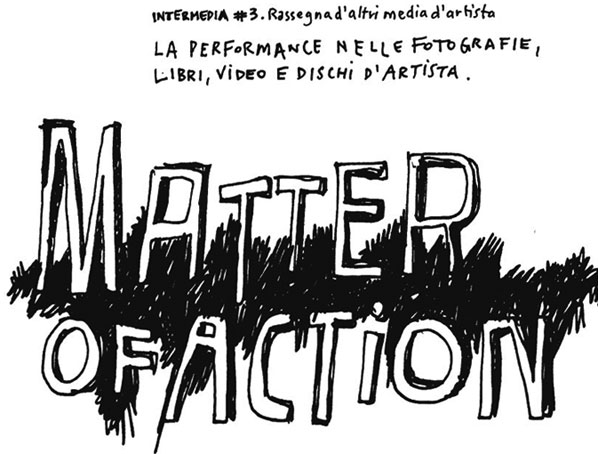
Matter of Action

Matter of Action is the third appointment of the INTERMEDIA cycle, an exhibition of alternative artist’s media - curated by Giorgio Maffei, Sara Serighelli, Fabio Carboni and Samuele Menin.
By nature, performance, happening, body art, action poetry are artistic actions aimed at lasting only for the short moment of their ritual fulfillment. This exhibition tries to stop the time focusing on the sequence of actions through those media able to give substance and duration to the performing event – photographs, records, videos and books. Through a set up that can appear disturbing, the exhibition wants to suggest a sharing experience of the contents based on the visitors’ perception.

Photographs, books, videos and the artist’s records hold the memories, preserving tracks and, at the same time, transcribing - with different tools - images, words and meanings of a way of making Art that has deeply affected the historical development of the second half of the 20th century.
All along the exhibition, art works from the 60s and 70s are gathered through necessary historical photographs to hint at the first performing actions of the Avant-garde and of the artists who, at the end of the ‘50s, turned their work toward the overtaking of the objectual form of the artifact. Duchamp, Man Ray, Dalí, then Manzoni with Klein and Fontana undertook the path which find its thoroughness both in the Conceptual and in the Arte Povera anvironment, as well as in Fluxus of the following decade. Allan Kaprow’s theorizations, Abramovic and Gina Pane’s actions, Nitsch and Muehl’s expressive violence, Acconci and Oppenheim’s body discipline, Ontani e Lüthi’s trasformism, Agnetti, De Dominicis and Nauman’s rigorous intellectual action, Kounellis and Calzolari’s theatrical behaviour, the use of their own face as expressive matter in Boetti, Penone and Zorio, and moreover, up to the overtaking of the disciplinary limits with the new music of Cage, Chiari and La Monte Young, the dance with Monk and Trisha Brown or poetry with Lora Totino, Spatola and Isou.

In a part of the exhibition Matter of Action, Italian artists have been invited to present in Milan a performance already made in their past, through two different ways: live performances with Italo Zuffi, Simone Berti, Giovanni Morbin, Christian Frosi & Diego Perrone, Dafne Boggeri, Nicola Ruben Montini, Michele Bazzana, Igor Muroni, as well as through some videos, with documents by Cesare Pietroiusti, Elisabetta Benassi, Lorenzo Scotto di Luzio, Cesare Viel, Patrick Tuttofuoco, Davide Savorani, Sissi (…). This part hasn’t the historical ambition to cover everything that has been happening in Italy during the last years, but it freely dots a temporal lapse through the actions of some artists who have occasionally or constantly used the performance in their research. These appointments draw possible trajectories and paths between historical experiences from the 60s and 70s up to contemporary episodes.

Over forty years after the publication of the text “Intermedia”(February 1966) by Dick Higgins in “The Something Else Newsletter”, the curators of this exhibition have borrowed this title which best expresses the need of contemporary culture to 'shuffle the cards,' to break down the strict barriers between disciplines and to consider art and its ways of expression as one singular creative process. The cycle of exhibitions develop through themes and segments: the first appointment of the cycle, ‘10 - a generation of artist's books, 1999-2009’ was held in September 2009 and the second ‘SUPERARCHITETTURA RADICALE books, posters, magazines’ in April 2010.

Performances:
venerdì/ Friday 11 feb. Nicola Ruben Montini
lunedì/Monday 14 feb. Igor Muroni
venerdì/ Friday 18 feb. Dafne Boggeri
lunedì/Monday 21 feb. Giovanni Morbin
venerdì/ Friday 25 feb. Michele Bazzana
lunedì/Monday 28 feb. Simone Berti
venerdì/ Frida y 4 mar. Diego Perrone & Christian Frosi
lunedì/Monday 7 mar. Italo Zuffi
All performances will be held at O’ via Pastrengo 12, Milano, 8.30 pm

Videos by: Moira Ricci, Cesare Pietroiusti, Giancarlo Norese, Luigi Negro, Emilio Fantin, Luigi Presicce, Cesare Viel, Nico Vascellari, Orthographe, Invernomuto, Giovanna Ricotta, Patrizio di Massimo, Sissi, Lorenzo Scotto di Luzio, Alessandro Ceresoli, Elisabetta Benassi, Alessandro Sciarroni, Patrick Tuttofuoco, Francesca Grilli, Michael Fliri, Davide Bertocchi, Paola Anziché, Marco Vaglieri, ZimmerFrei, Enzo Umbaca, Marcella Vanzo, Davide Savorani, Filippo Berta.

info:
O’, o AT o-artoteca DOT org
Giorgio Maffei, info AT giorgiomaffei DOT it

O'
via pastrengo 12, 20159 milano
www.on-o.org

January 15, 2011

Four Blindfolded Dialogues and Transcripts

Steve Piccolo, Milano
Mon, 6 Aug 2007 14:16:37

I’m writing this in English because I’m blindfolded and I can’t find the accents on the keyboard in Italain. This is the final segment of an hour spent in various sensory depraivation modes in an attempt to generate some kind of long distance psychich contact among our group. At first I was expecting a signal on Skype as plannned, but then I realized that the short text msg on the phone was the only hint to begin. I thought of Emilio and realized that was how he would do it. I put on my glasses with paper taped over the lenses. I thought a partial blindfold might resemble, more closely, the post-op condition of Luigi. A bit of peripheral vision, light that enters from the sides, not impossible to get oriented in a room, but impossible to actually do anything constructive. Or not?

I was holding my guitar when the experiment started so I began playing. Thirty minutes of so passed in a flash, the playing was long and slow and meandering, much more concentrated than usual, very patient about thematic development, returning again and again to growing patterns. I was playing for Luigi and for everyone who mighht be listening.

Then I realized that this was just too damn easy. For a musician, being deprived of sight is a boon, at least for playing. Just look at this text I have typed without ever removing the blindfold. I can’t see it, but I’m sure it has very very few mistakes. Myfingers can tell what is happening. There is probalbly a mistake near ‘fingers’, and probably another one near the start of this sentence.

I thought maybe I should try being deaf instead of blind. So I removed the blindfold. It was true, a half hour had passed. I found my super earplugs in the bathroom and stuffed them into my ears. Now it was possible to take a piss, to smoke a cigarette, all things I had been putting off because being sightless made them difficult. I thought about Luigi and realized that this solution was also too easy. So I put the papered bglasses back on. At this point I was semi-deaf and semi-blind. Void. Noresian silence. I wondered how Luigi manages to use the microtrack to make recordings if he can’t see. I know that machine very well, use it every day, I can even find it in the mess on my work table with my papered glasses on. So I tried recording something. It was nearly impossible.
Not enough audio feedback signals for the functions.
Even with earbuds instead of earplugs it wasn’tpossiblel to really get any work dpme.

Suddenly the time got endless. We were all just sitting there, I thought, Cesare, Luigi, Giancarlo, Emilio, me. Or lying down. I had set my mobile phone alarm so I’d know when the hour was up. Maybe it wasn’t working. Maybe I set it wrong.It seemedlike much more than an hour had passed. I could imagine the others, blindfoldied, mpo longer trying anything in particular, just resting or waiting for the end of the experiment. I knew they were doing that, but they might also have fallen asleep. After lucnch. I felt lonely. The visible objects around us keep us company, looking at them fills up time, adds a rhythm of references to things and when that rhythm is gone everything slows down.

I wondered if the others were really doing the experimnt or if I was the only one, sitting in my hot studio in Milan weeearing glasses with paper taped over the lense. So I saaat down at the computer and started writing these thoughts, before they vanished, like dreams in the morning. In the middle of the process the mobile phone alarm went off. The hour was up. In that split second something hit me. The body, the body detached from its surroundings by sensory closure. It wasn’t necessary but I put on a real blindfold and put the earplugs back in and concentrated on the image that was growing. It was a sexual fantasy, and in this blocked condition it was particularly vivid. The goddess smiled and told me that bodies can heal themselves especially when they know desire and cultivate it in union with other bodies. She beckoned to me, I reached out and caressed the column of hot air blowing out of the fan on my desk…

So in a way I blew it. The hour is up and finally, now, I have some positive energy to send. Hope it’s not too late.


Cesare Pietroiusti, New York
9 agosto 2007, 5.05

Dunque trascrivo gli appunti che ho preso subito dopo l'ora passato bendato. Contesto: ero a casa, alle 9 di mattina, Carolyn e Pinki dormivano. Ho usato una benda da aereo che non lasciava filtrare quasi niente di luce, comunque sono stato per lo più con gli occhi chiusi, salvo in un paio di occasioni in cui li ho aperti automaticamente, come risposta a un rumore improvviso.

Subito ho notato la lentezza dei movimenti e dei gesti e ho pensato che, a parità di tempo, si possono fare meno cose in tale condizione. Poi ho pensato al fatto che bisogna avere una maggiore attenzione alle proprie memorie a breve termine: bisogna ricordare dove si è appena lasciato il bicchiere, per esempio, per non rischiare di romperlo... è un po' come se tutte le "situazioni" pre-esistenti (oggetti, mobili, persone) debbano essere presenti alla memoria.

Ho notato l'importanza dei rumori che si producono: i passi sul pavimento, l'urto contro un oggetto, tutto contribuisce a dare informazioni sulla propria posizione e sui rischi che si stanno correndo, ma c'è anche un aspetto di puro e semplice piacere nel sentire i rumori che si producono abitualmente con una nuova intensità e precisione. A un certo punto ho acceso la radio e ho dovuto mettere il volume bassissimo, molto più basso del normale, perché la musica mi disturbava e mi confondeva (in genere mi succede il contrario).

Ho pensato che un appropriato sistema di segnali sonori associati a ogni oggetto, anche piccolo, di una casa, consentirebbe di muovercisi con la stessa velocità e precisione come se ci si vedesse. Le mani (in piccola parte anche i piedi) delimitano continuamente un "campo", fatto in genere di linee dritte o di angoli netti, in cui, momento per momento, ci si può muovere e si può agire: i punti di riferimento spaziali (la linea dritta di un armadio, l'angolo di un rivestimento sul muro) sono fondamentali e usati continuamente.

Ho avuto la sensazione di essere stato sempre presente a me stesso, in una specie di costante auto-osservazione, e che ci fosse un costante flusso di pensieri legati alla particolare situazione che veniva prodotto (e che, probabilmente, pensavo, non sarei stato in grado di recuperare...). Solo in un determinato momento (probabilmente verso il 40º minuto) ho abbandonato questa situazione di auto-osservazione e mi sono sentito "normale", non in condizione di deprivazione né in una situazione di esperimento.

Mi sembrava di avere molte idee, anche interessanti... ma non saprei dire quali fossero. Forse quella di fare l'ultima parte dell'intervento per S.C. "a distanza" dialogando con il pubblico in una qualche situazione di deprivazione tipo questa, per email.

La cosa che mi ha dato più fastidio è stata la confusione dentro il frigorifero (troppe cose, mescolate disordinatamente). Ho pensato che per chi ha problemi gravi di vista, è necessario un grande ordine e poche cose.

A un certo punto ho sentito qualcuno che si muoveva per casa e mi sono sentito un po' in imbarazzo (anche se tutti erano stati avvisati che avrei fatto questo esperimento). Però quello è stato l'unico momento in cui stavo per togliermi la benda. peraltro credo che il rumore che avevo sentito
provenisse da fuori.

Durante l'ora da bendato ho fatto colazione (latte di riso, pane abbrustolito con burro). Nonostante quello che mi aspettavo il senso del gusto non è affatto aumentato durante questa esperienza; al contrario, mi è sembrato di avere un gusto molto atrofico, e quasi di non essere in grado di sentire nemmeno che alcune parti della fetta di pane che avevo tostato erano, in effetti, bruciate.

Complessivamente però l'esperienza ha avuto degli evidenti caratteri "sensuali" – si sente l'aria, si sente molto di più tutto – con una discreta "erotizzazione" (diciamo così) del mio stato mentale dopo l'ora passata bendato.

In modo esplicito nessuno di voi mi è venuto in mente. Ho "visto" solo Luigi, due o tre volte, con degli occhiali a volte opachi, sempre accompagnato da una ragazza...


Giancarlo Norese, Novi Ligure
6 agosto 2007

un'ora bendati (tentativo di trasmissione del pensiero)

Paura (prima parola).
Fischiano tantissimo le orecchie.
Io + Luigi = un uomo morto.
Africa.

(Pausa, causa panico. Mi tolgo la benda e la rimetto)

Emilio: Mi sentite?
Giancarlo: OK.
Luigi: Nonostante il fischio... Potete capirmi meglio, ora.
Cesare: Debbo dire che è una condizione non male, per certi versi…
L.: Aspetta a dirlo, vedrai.
G.: Io mi sto cagando sotto…
E.: Devo dire che ha qualcosa di grottesco, questa condizione. Ma ditemi, voi che fate? Siete in piedi o seduti?
L.: Io a letto.
C.: In piedi, sto cercando di bere.
G.: Seduto, sto scrivendo di voi, a ciò che pensate.
E.: Anch'io sono in piedi.
C.: La cosa lampante è che i suoni assumono tutta un'altra dimensione, oserei dire inquietante.
E.: Sentite, posso chiedervi quale film avete visto ultimamente?
L.: Io nessuno…
C.: Io ho visto uno strano film di Antonioni fatto con un cinese e un altro tizio, "Eros".
G.: Io un magnifico film di Aldo Lado (che sembra uno che usa sempre le stesse lettere), degli anni 70; in francese si intitola "Je suis vivant", è la storia di uno in catalessi che cerca di ricordare il proprio passato ma che alla fine subisce un'autopsia, pur essendo ancora vivo.
E.: (incomprensibile)
L.: Direi che ha un po' a che fare con la nostra situazione: cercare di parlare senza avere la facoltà del linguaggio, isn't it?
C.: Come un trapezista senza trapezio.
Steve: Ehi, ci sono anch'io!
Maddalena: E pure io…
G.: Stavo giusto pensando alla tua voce che ci legge le storie del Cafausu…
S.: That's why you've heard something in English.

(Mi addormento. Alle 16 suona la sveglia)


Emilio Fantin, Bologna

Immagine centrale: siamo tutti riuniti vicino a un albero secco, vedo chiaramente tutti, una grande albero secco. Luigi ha i suoi occhiali da sole e sento la sua voce dire: non abbiamo trovato questa figura. Tutto intorno il deserto.
Inizio con questa immagine perché è l'unico momento in cui mi rendo conto di avere una visione non voluta, assolutamente imprevista (non sto sognando, sono perfettamente conscio); accade pressappoco a metà e dura pochissimo. Il resto del tempo mi sforzo di entrare nella testa di Luigi per assorbirne il dolore, l'inquietudine, la preoccupazione. Mi domando che cosa sia questo "gioco" rispetto alla sofferenza vera.

Inadeguato e insufficiente, così mi sento, ma porto il pensiero agli altri: Cesare, Giancarlo Steve e Luigi naturalmente. Il fatto di sapere che altri sono bendati come lo sono io mi consola e mi sembra di percepire una forza vera, composita, che spinge verso Luigi. Si agitano davanti a me forme nere su nero, fluttuanti. Poi mi acquieto e passo un periodo di transizione apparentemente senza trovare connessione alcuna. Ora ho un ago di una siringa che mi trafigge l'occhio, per sottrarmi a questa sensazione dondolo la testa a destra e a sinistra ma non passa così velocemente.

Usciti da questa situazione inquietante segue un nuovo un periodo di calma indifferente. Poi mi viene un colpo di sonno che combatto ributtandomi dentro la testa di Luigi e ascoltando l'emicrania (la sua). Mi rendo conto che a volte associo le persone a delle immagini che già conosco, come per esempio cesare che nell'appartamento di Manhattan siede semisdraiato vicino alla finestra. Si deve fare attenzione a separare le immagini della memoria (già vissute) con quelle che appaiono del tutto nuove.

Sono di due tipi diversi. Le prime sono legate alla conoscenza e ai rapporti avuti in precedenza con i partecipanti. È per questo che sento steve più lontano di gianca e cesare, forse perché non ho molte immagini da associargli. Durante tutto il tempo, a più riprese e a fasi alternate, ascolto la forza della condivisione tra noi cinque ma è allo stato istintivo e non riesco a selezionare le varie forze individuali. A un certo punto, credo verso la fine, sento la voce di qualcuno di noi (una voce metallica), non ricordo cosa dice, ma l'immagine che riflette è un rettangolo (uno schermo?) buio, nero.

Passa qualche istante e la voce di cinzia mi avverte che sono le quattro e dieci: sono sorpreso, pensavo di dovere restare al buio più a lungo, è già passata un'ora.  Sento il bisogno di comunicare subito quello che in me è ancora fresco e vivo. Ho la sensazione di avere ancora molte cose da dire ma non sono in superficie, mi manca l'altra parte di "noi", cioè voi, per acciuffarle.

January 10, 2011

Little Constellation Library Archive

A specialized library and archive, with books and documentation on contemporary art in the micro geo-cultural areas and small states of Europe.

On Saturday, January 29, 2011, has been opened the Library Archive of Little Constellation with the participation of the Capitano di Castello (Mayor) of Serravalle, the Ambassador to the OSCE and a large audience of young people interested in culture and contemporary art. Alessandro Castiglioni, curator and art historian, and Rita Canarezza & Pier Paolo Coro presented the characteristics of this first research center and specialist archive, freely available for consultation, which comprises some 415 volumes, including a number of rare books and publications on contemporary art, which were collected in seven years’ work in Europe, and particularly in the small European states: Andorra, Cyprus, Iceland, Liechtenstein, Luxembourg, Malta, Monaco, Montenegro, San Marino, and in a few european geocultural micro-areas including Canton Ticino (CH), Ceuta (E), Gibraltar (UK), Kaliningrad (RU). The occasion was marked by presentations and artistic interventions.
Little Constellation, by means of a constant work on international art, now restores a social space for culture and research to the territory of San Marino. All this has been possible thanks to the interest and support of private and public organizations, which have invested in an innovative art project, which is now part of the common heritage.

Artists and curators archive library collection: Danil Akimov, Pier Giorgio Albani & Lorella Mussoni, Eve Ariza, Sigurður Atli Sigurðsson, Javier Balmaseda, Sigtryggur Berg Sigmarsson, Gerson Bettencourt, Barbara Bühler, Austin Camilleri, Rita Canarezza & Pier Paolo Coro, Martina Conti, Viola Conti, Alessandro Castiglioni, Umberto Cavenago, Mirjana Dabovic’ Pejovic’, Nina Danino, Roberto Daolio, Oppy De Bernardo, Eleanor Duffin, Haris Epaminonda, Sandrine Flury, Marco Franciolli, Barbara Geyer, Gino Gianuizzi, Mario Gorni, Helena Guardia, Ásdís Sif Gunnarsdottir, Susana Herrador, Anna Hilti, Hekla Dögg Jónsdóttir, Dorothée Kirch, Irena Lagator, Jose Ramón Lozano, Enrico Lunghi, Ingibjörg Magnadóttir, Friedemann Malsch, Mark Mangion, Louli Michaelidou, Kevin Muhlen, Thomas Negrevergne, Giancarlo Norese, Bjargey Ólafsdóttir, Chistodoulos Panayiotou, Paradise Consumer Group, Lazar Pejovic’, Pierre Portelli, Polys Peslikas, Quino, Svetlana Racanovic’, Agnès Roux, Halldór Björn Runólfsson, Gino Sanguinetti, Christian Schoen, Socrates Socratous, Noah Stolz, Teatrutramm, Matteo Terzaghi & Marco Zürcher, Jelena Tomaševic’, Yiannis Toumazis, Evgeny Umansky, Axsinja Uranova, Valentina Vetturi, Natalija Vujoševic’, Martin Walch, Trixi Weis.

A project by NUA new contemporary arts and research; project partners: Social and Cultural Activities Office; Fondazione San Marino (main sponsor); Ente Cassa of Faetano.
Cultural partners: MUDAM Musée d’Art Moderne Grand-Duc Jean, Luxembourg; Casino Luxembourg - forum d’art contemporain, Luxembourg; CIA.IS Centre for Icelandic Arts; National Gallery of Iceland; Living Art Museum, Iceland; Cultural Services Cyprus; The Nicosia Municipal Arts Centre, Cyprus; Malta Council for Culture and the Arts; MCA Malta Contemporary Art Foundation, Malta; Ateljer Dado, National Museum of Montenegro, Cetinje; Montenegrin National Theater; Centre for Contemporary Art, Podgorica, Montenegro; Serveis Culturals Andorra; Escola d’Art la Llacuna, Andorra La Vella, Andorra; Museo Cantonale d’Arte, Lugano; La Rada, Locarno, Canton Ticino / CH; Dirección Provincial de Educacion; Instituto De Bachillerato Siete Colinas, Ceuta / E; Ministry of Culture, Heritage, Sport & Leisure, Gibraltar; Fine Arts Association Gallery, Gibraltar / UK; Kaliningrad Branch of The National Centre for Contemporary Arts; Ministry of Culture of the Kaliningrad Region; Department of the Kaliningrad Regional Government, Kaliningrad / RU; Kulturstiftung Liechtenstein; BBKL Liechtenstein; Kunstmuseum Liechtenstein; Neon Gallery, Bologna /I.
For more information about the book, the projects, the artists and the institutions of Little Constellation network: www.littleconstellation.org

NUA new contemporary art and research
str. Lamaticcie 54 Serravalle 47890
Republic of San Marino
nua AT omniway DOT sm

January 4, 2011

Illustre Scultura Polimaterica. Il libro

Illustre Scultura Polimaterica. Il libro
A cura di Rita Correddu e Alice Militello
giovedì 27 gennaio 2011, ore 21
Librerie Coop Ambasciatori, via Orefici 19, Bologna

Presentazione del libro che documenta il progetto “Illustre Scultura Polimaterica” realizzato nel gennaio 2010 presso gli spazi del Link Associated.
L’incontro si pone quale momento per discutere insieme agli artisti Emilio Fantin, Luigi Negro, Giancarlo Norese e Cesare Pietroiusti, del processo di attuazione del lavoro.
La presentazione sarà accompagnata dalla proiezione di immagini di archivio. Dialoga con gli artisti Francesca Marianna Consonni, responsabile Dipartimento Educativo del Maga – Museo Arte Gallarate.

Progetto ArtePubblica